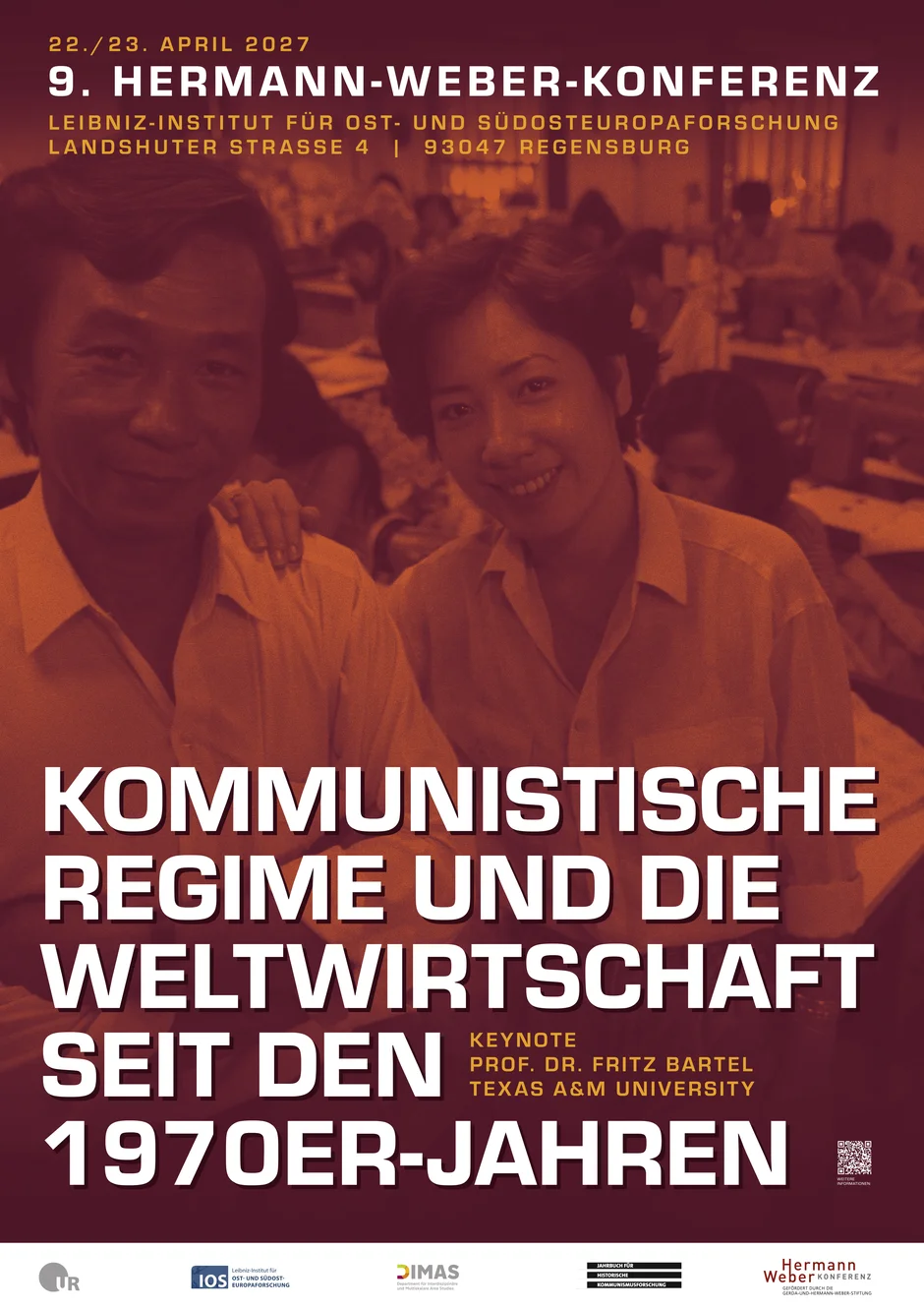
April 22–23, 2027
University of Regensburg in Collaboration with the Leibniz Institute for East and South-East European Studies (IOS)
Venue: Leibniz Institute for East and South-East European Studies (IOS), Landshuter Straße 4, Room 319, 93047 Regensburg
Publication: Selected papers will be published in the Yearbook for Historical Research on Communism (2029 edition).
Conference Languages: English and German
Communist regimes of various kinds were committed to overcoming capitalism, but they operated in the context of a dynamically changing capitalist global economy. The 9th Hermann Weber Conference investigates the consequences of this tension from the early 1970s through the collapse of state socialism and beyond.
Bringing together cutting-edge research from political, economic, and global history, this conference examines how different communist states—from the Soviet Union and Eastern Bloc to China, Yugoslavia, and Cuba—navigated financial globalization, debt, geopolitical interests, and ideological transfers. Revised versions of selected conference papers will be published in the 2029 edition of the Yearbook for Historical Communist Studies (Jahrbuch für Historische Kommunismusforschung).
The featured keynote speaker for the Hermann Weber Conference is Professor Fritz Bartel (Texas A&M University), author of The Triumph of Broken Promises: The End of the Cold War and the Rise of Neoliberalism (Harvard University Press, 2022).
The 9th Hermann Weber Conference is generously supported by the Gerda and Hermann Weber Foundation.
A printed conference program will be available later this winter.
Conference Organizers: Ulf Brunnbauer, Timothy Nunan
Conference Program
Thursday, April 22, 2027
9.00–9.15
Welcome by Ulf Brunnbauer and Timothy Nunan
Panel I: Global Finance, Debt and the IMF
Panel Chair: Matthias Morys
9.15–9.30
Federico Pachetti: The Forgotten History of Structural Adjustment: China and the IMF during the Early Reform and Opening Up
9.30–9.45
Eva-Maria Muschik: Challenging Structural Adjustment in Divided Berlin: The 1988 East German Protests Against the IMF and the World Bank
9.45–10.00
Ștefan-Marius Deaconu and Bogdan Murgescu: Ideology, Sovereignty and Debt: East European Responses to Creditor Conditionality in the Late 1970s and 1980s
10:00–10:15
Comments from the panel chair
10.15–10.45
Q&A
10:45–11:00
Coffee break
Panel II: Extractivism, Mining and Resource Flows
Panel Chair: Tamar Qeburia
11:00–11:15
Nikolai Erofeev: Soviet Mining Joint Ventures in Mongolia and the Socialist Roots of Global Extractivism
11:15–11:30
Jan Koura: From Trade to Joint Venture: Czechoslovakia, Zambia and Copper Mining in the 1970s
11:30–11:45
Karolina Partyga: What the Future is Made Of: Polish Efforts to Reimagine Raw Material Flows 1976–1985
11:45–12:00
Comments from the Panel Chair
12:00–12:30
Q&A
12.30–13.30
Lunch break
Panel III: The Socialist ‘Third World’ and Models of Development
Panel Chair: Timothy Nunan
13:30–13:45
Berthold Unfried: The Special Case of Cuba: The Council for Mutual Economic Assistance, the World Market and the Cuban Way
13:45–14:00
Paul Stubbs: Socialist Yugoslavia and the New International Economic Order: A Thrice-told Tale
14:00–14:15
Comments from the Panel Chair
14:15–14:45
Q&A
14:45–15:15
Coffee Break
15:15–15:45
Notes on the Publication of Conference Papers by Birte Meyer
15:45–16:00
Break
Keynote Address
Moderation: Timothy Nunan
16:00–17:30
Fritz Bartel (followed by a Q&A session)
17:30–18:30
Down Time
18:30
Dinner at a Restaurant in Regensburg’s Old Town
Friday, 23 April 2027
Panel IV: Intellectual Exchange and Debates on Reform
Panel Chair: TBA
09:00–09:15
Alice Trinkle: A Global Reform Socialist Movement? Insights into Chinese–Eastern European Exchanges on Economic Reforms
9:15–9:30
Yating Zhang: The German Pathway to Neoliberalism: Sino-German Intellectual Exchange and the Social Market Economy in China
9:30–9:45
Olga Trufanova: Limits to Growth in State Socialism: A Comparative Overview
9:45–10:00
Comments from the Panel Chair
10:00–10:15
Q&A
10:15–10:45
Coffee Break
Panel V: Integration, Infrastructure and Shocks
Panel Chair: Ulf Brunnbauer
10:45–11:00
Michael De Groot: The Oil Countershock, the Plaza Accord, and the CMEA
11:00–11:15
Steven Harris: The Soviet Response to Sanctions: Aeroflot in the World Economy of the Late Cold War
11:15–11:30
Irina Morozova: COMECON, Soviet Neocolonialism, and the MPR’s Leadership: Deciding the Course of Economic Reform
11:30–11:45
Comments from the Panel Chair
11:45–12:15
Q&A
12:15–13:15
Lunch Break
Panel VI: Banks, Markets and Prices
Panel Chair: Mladen Zobec
13:15–13:30
Marcus Dietrich: Socialist Banks, International Finance and Eurodollar Markets
13:30–13:45
Emilija Cvetković: An Attempt to Create an Atmosphere: The International Investment Corporation for Yugoslavia in the 1970s
13:45–14:00
Johannes Gleixner: Pressure for Reform From Within or From Without? Prices in Czechoslovakia in the Late 1970s
14:00–14:15
Comments from the Panel Chair
14:15–14:45
Q&A
14:45–15:15
Coffee Break
Panel VII: Work, Mobility and the Soviet Periphery
Panel Chair: TBA
15:15–15:30
Tatiana Sitchinava: Internal Mobility, Labour Migration and Remittance-like Practices in Late Socialism: The South Caucasus
15:30–15:45
Siarhei Bohdan: The Clash of Socialist Superpowers and Socio-Economic Development in the Central Asian Soviet Republics
15:45–16:00
Zarnigor Khayatova: Foreign Debt, Raw Materials, and Late Soviet Uzbekistan in the Global Economy
16:00–16:15
Comments from the Panel Chair
16:15–16:45
Q&A
16:45–17:00
Closing Remarks by Ulf Brunnbauer and Timothy Nunan
17:00–18:30
Down Time
18:30
Dinner at a Restaurant in Regensburg’s Old Town