Information for best getting started
First Orientation
- Study Plans: Here you’ll find recommendations for study plans with as little overlap as possible.
- Course Catalog/SPUR: Here you’ll find up-to-date information on your courses.
- E-Learning GRIPS: Lecturers make their teaching materials available to you on GRIPS. You’ll receive information and registration codes for the individual GRIPS courses during the first class session.
- Chemistry Exam Schedule: Most chemistry exams in the M.Sc. in Business Chemistry program are organized centrally. The dates for both regular and retake exams are set by the start of the semester at the latest to allow you to plan as effectively as possible.
- FlexNow: FlexNow is the University of Regensburg’s exam management system. This is where you register for exams and lab sessions in a legally binding manner.
- Webmail/GroupWise: You can access your student email account via GroupWise. Please check your email regularly and always use your student email address for communication within the UR.
- Examination Regulations : The Examination Regulations, as of 26/08/2026, govern your master’s program.
- Module Catalog: The Module Catalog lists and describes all the modules you must complete during your studies.
Important: Since new examination regulations will take effect for the 2026/27 winter semester, preparatory work (SPUR, FlexNow, etc.) is still required. This work may continue until the start of the lecture period. Please be patient for a little while longer. Thank you for your understanding.
Study Structure
Core Module Groups
In the Master’s Degree Program in Business Chemistry, you will select one core module group from the field of Economics worth 24 LP, as well as three core module groups in Chemistry, each worth 12 LP. The chosen Ecomomics specialization is combined with two additional compulsory-elective modules, to be selected from the remaining core module groups (6 LP each). You may choose from the following specializations in chemistry and economics:
Exonomics: (1 out of 5)
- Core Module Group 1 Management and Leadership
- Core Module Group 2 Finance
- Core Module Group 3 Industrial Management
- Core Module Group 4 Marketing
- Core Module Group 5 Digital Business
Chemistry: (3 out of 4)
- Core Module Group 1 Inorganic Chemistry
- Core Module Group 2 Organic Chemistry
- Core Module Group 3 Physical Chemistry
- Core Module Group 4 Bioanalysis
Advanced Modules
The core module groups are followed by three advanced modules. These modules prepare students for their thesis through a chemistry research lab course (Advanced Module in Chemistry, 6 CP) and a ecomonics seminar (Advanced Module in Economics, 6 CP), in which scientific research methodology is taught and practiced using case studies. The Advanced Module in Business Chemistry (6 LP) focuses on the “sustainability assessment of chemical products and processes.”
You can complete the Advanced Module in Chemistry at any time of your choosing at the Institutes of Analytical Chemistry, Chemo- and Biosensors (external link, opens in a new window), Inorganic Chemistry (external link, opens in a new window), Organic Chemistry (external link, opens in a new window), or Physical and Theoretical Chemistry (external link, opens in a new window).
Seminars for the Advanced Module in Economics are offered in both the winter and summer semesters by professors in the Department of Economics, as well as by Prof. Dr. Weckenborg (Chair of Business Chemistry). Please check the professors’ websites or the course catalog well in advance (during the previous semester) for more information.
The Advanced Module in Business Chemistry is offered by Prof. Weckenborg (Chair of Business Chemistry). It is always offered during the winter semester and will be offered for the first time in the winter semester of 2026/27.
Master's Thesis
The Master’s Thesis is a nine-month interdisciplinary final project that must incorporate aspects from both subdisciplines. It is supervised and evaluated by both a professor from the Faculty of Chemistry and Pharmacy and a professor from the Faculty of Economics. Prof. Weckenborg, Chair of Business Chemistry, can serve as the advisor for both the Faculty of Chemistry and Pharmacy and the Faculty of Economics.
Exams
Exam Registration
Chemistry exams are expected to be available on FlexNow starting October 1, 2026.
- FlexNow registration for Chemistry: October 1, 2026, through no later than five business days before the exam
- FlexNow withdrawal from Chemistry (no reason required): October 1, 2026, through no later than one day before the exam
The exam schedule for the Department of Economics will be available at a later date. The Examination Office Ecomonics will announce the official registration period.
- FlexNow withdrawal from Economics (no reason required): no later than one week before the exam
Oral Examination in the Core Module Group Bioanalysis
Special exam periods and registration deadlines apply to the oral exam in the Bioanalytics basic module group. The oral exam may only be taken on the first attempt during the following times:
- September 1 - December 15 (Preferred exam period for all students starting their master's program in the winter semester)
- February 1 - February 28 (29)
- April 1 - June 30
For this oral module exam, you are generally free to choose your own date and examiner within the exam period!
Please be sure to note that there are fixed and mandatory registration periods for the two-step registration process for this exam:
- step 1: Schedule an appointment via TEMPO
- step 2: Registration in FlexNow
You can always find the Announcement of the registration period in a timely manner on the Chemistry Examination Office website (Mandatory Registration/Exam Periods for the Master's Program).
Further Information on the Master's Degree Program in Business Chemistry
Contact
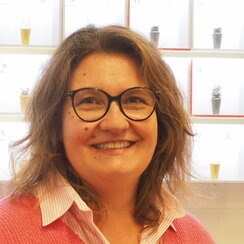
Dr. Claudia Wanninger-Weiß
Program Coordination and Study Advisory specialised for (Business) Chemistry
-
E-mail address: studienberatung.chemie(at)ur.de
(opens your email program)
Secondary e-mail address: claudia.wanninger-weiss(at)ur.de (opens your email program) - Tel: +49 941 943 4573 (starts a telephone call, if your device allows this)
- Location: Chemistry and Pharmacy, CH 3.1.87
-
Important information: Programs: Chemistry (B.Sc./M.Sc.), Business Chemistry (B.Sc./M.Sc.), Medicinal Chemistry (M.Sc.)
Office hours are typically Monday and Thursday, Consultation appointments by arrangement