


What is an animal experiment anyway?
The term "animal experiment" is clearly explained in Section 7 of the German Animal Welfare Act. Not every use of animals or animal products in research is an animal experiment. For example, working with embryos or larvae up to a certain stage of development is not subject to the requirements for animal experiments. The killing of untreated animals in order to use their organs for research purposes also does not constitute animal testing according to Section 4 (3) TierSchG. On the other hand, any manipulation of a living animal that can lead to pain, suffering or harm is classed as animal testing. The term "animal experiment" therefore also covers procedures in research that are hardly stressful. These include, for example, injections carried out as in veterinary practice, clinical studies on the use of a drug in veterinary patients as well as the anaesthetisation and animal tagging of wild animals. Overall, the term "animal experiment" only allows limited conclusions to be drawn about the pain or stress to which the animals are exposed.
Why are animal experiments carried out at the University of Regensburg?
There is currently no alternative to animal testing in some areas in order to lay the foundations for progress in biology and medicine. Not all processes in an organism can be modelled and understood using animal-free methods. For example, the functions of the immune system, cognitive processes, but also complex disease models (e.g. tumours) can only be partially investigated outside of a living organism. Animal experiments at the University of Regensburg are mainly carried out as part of basic biomedical research as well as translational and applied research (e.g. therapy and diagnostics of human diseases).
The general rejection of animal experiments is often justified by the fact that the results from animal experiments cannot be transferred to humans and the experiments therefore have no benefit. Around 90 % of the drugs used in veterinary medicine are also used in medicine. This speaks against the very simple view that categorises humans as a species that is completely separate from the other mammalian species. From a scientific point of view, the Nobel Prizes "for the most important discoveries in the domain of physiology or medicine", which have been awarded since 1901, demonstrate the importance of animal experiments in biology and medicine. Almost 90 per cent of these prizes were awarded for research projects in which studies on animals or animal tissue played a central role. More than 50 of these Nobel Prizes were awarded for work involving experiments on living vertebrates.
A detailed explanation of the necessity of animal experiments in research using representative examples from biomedical research can be found in the information brochure Animal Experiments in Research | PDF (external link, opens in a new window) published by the German Research Foundation (as of July 2019).
The Alliance of Science Organisations also offers comprehensive, up-to-date information on many aspects of animal experiments under the motto Understanding animal experiments - a science information initiative (external link, opens in a new window) (German version only).
On which species are animal experiments carried out at the University of Regensburg?
Small rodents such as mice and rats are used for most experiments (> 95 %). For very specific questions, rabbits are occasionally used. No experiments with dogs, cats or primates are carried out at the University of Regensburg.
Which questions are addressed in animal experiments at the University of Regensburg?
Animal experiments at the University of Regensburg are carried out by the Faculties of Medicine, Biology & Preclinical Medicine and Chemistry & Pharmacy. The main areas of research in which animals are used include: Tumour research, cardiovascular research, immunology, infectious diseases (bacteria, viruses, parasites), musculoskeletal diseases and diseases of the nervous system. The experiments are mainly used for basic biomedical research as well as translational and applied research (e.g. therapy and diagnostics of diseases). The results are regularly published in relevant scientific journals. The publication lists can be viewed on the pages of the respective chairs.
How are animal husbandry and animal experiments monitored?
In accordance with Section 8 TierSchG, every planned animal experiment must be submitted to the competent authority with a detailed written justification and proof that the organisational and personnel requirements for conducting the experiment are met. The government of Lower Franconia (external link, opens in a new window) is responsible for Regensburg.
The applications are also assessed by an ethics committee, whose representatives from science and animal welfare are appointed by the authorising authority in accordance with Section 15 (1) TierSchG. When carrying out the experiment, the information and conditions in connection with the authorisation must be strictly adhered to.
Regular on-site inspections of animal husbandry are carried out by the Environmental Agency of the City of Regensburg, Department of Veterinary and Consumer Protection (external link, opens in a new window). A large proportion of the inspections are unannounced. This means that the official veterinarians appear on site without prior notice and directly inspect all animals in an animal husbandry area as well as the associated documents and compliance with legal and official requirements. The official veterinarians must be granted unrestricted access and insight into all records.
Regular in-house inspections are carried out by the animal welfare officers, who are veterinarians with specialised, 4-year additional training. The animal welfare officers are supported in their work by the statutory animal welfare committee. In addition to the vets, a team of specially trained animal keepers and technical staff are available 7 days a week to ensure the welfare of the animals.
Can animal testing applications be rejected by the competent authority?
The animal experiment application must be submitted to the authorisation authority in a precisely defined form (see forms of the Government of Lower Franconia (external link, opens in a new window)). Only when all formal requirements have been met will the veterinarians in Department 54 of the Government of Lower Franconia review the scientific explanations. If anything is unclear, further questions are asked and the applicant scientist may comment on these. The entire procedure usually takes several months, but can sometimes take well over a year. Authorisation is only granted if all queries from the government and the Section 15 Commission have been answered in a comprehensible manner and the animal experiment is deemed unnecessary. Otherwise, the application is rejected. However, this rarely happens because scientists usually improve their project in dialogue with the authorities until it fulfils all criteria and is eligible for approval.
Where can I find figures on the animal experiments carried out at the University of Regenburg?
The numbers of animals used in experiments or otherwise bred and killed in the context of laboratory animal husbandry at the University of Regensburg are recorded on a project-specific basis by the respective working group or the responsible experimenters. They are submitted annually to the Environmental Agency of the City of Regensburg and from there to the BfR (Federal Institute for Risk Assessment) in accordance with the Experimental Animal Reporting Ordinance. After verification, the figures for the whole of Germany (external link, opens in a new window) are published annually on the Bf3R website (external link, opens in a new window).
The current figures for the federal state of Bavaria can be viewed in the Compass Animal Experiments (external link, opens in a new window) (German version only) section of "Understanding Animal Experiments".
It is interesting to note that of the total number of animals killed in Germany, less than 1 % are used for scientific purposes. The majority of approx. 95 % is used for human consumption and approx. 5 % is used to feed pets (especially cats and dogs).
Why does the University of Regensburg not exclusively use alternative methods instead of animal experiments?
Wherever possible, experiments are always carried out at the University of Regensburg on painless material instead of animals. This includes biochemical preparations, cells, cell clusters, isolated organs and computer models.
However, there are still various limits to these methods. For example, although individual organs or even certain organ systems of humans can already be reproduced in miniature ("organ-on-a-chip"), the functions of the immune system or the brain, for example, cannot be imitated. The lifespan of such structures is also limited, meaning that they cannot yet be used for long-term studies. The same applies to completely animal-free in silico methods (i.e. computer simulations), which can also only reproduce a limited spectrum of the functions of the (human) body.
What is being done at the University of Regensburg, apart from research into alternative methods, to improve the lives of animals in experiments?
Scientists working in laboratory animal science at the University of Regensburg are committed to Russell & Burch's "3Rs" principle when using animals.
In addition to the use of animal-free methods (= replacement), this also includes working towards a reduction in the number of animals used and continuous optimisation with regard to animal welfare (= refinement). Refinement includes, for example, improved housing conditions with enrichment (= housing, play material) in the cages, the use of particularly gentle methods when handling animals and the use of training methods to reduce stress in later experiments, but also the replacement of invasive methods with gentler methods (e.g. use of non-invasively obtained material to detect genetic changes in mice). This concept also includes not working with mammals if less developed species can be used. For example, the university supports research projects in the field of basic research on ants, bees and sea anemones.
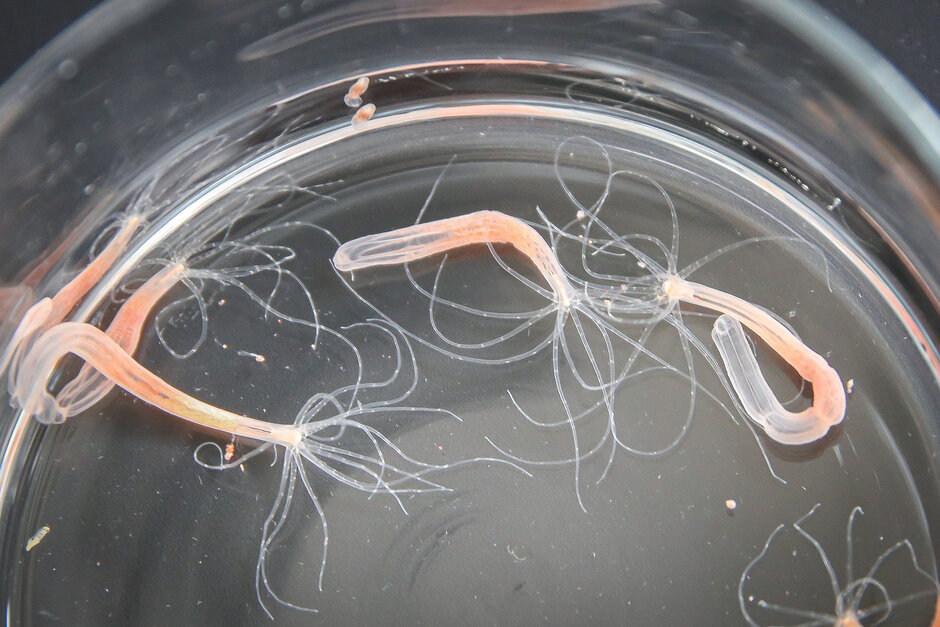 Foto: UR