

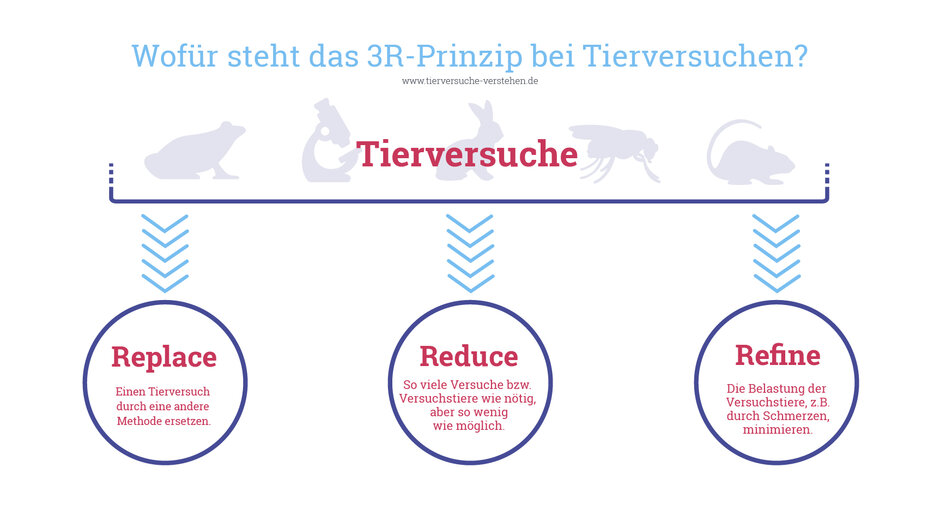
Replace
"Replace" means replacing animal experiments with suitable alternative methods whenever this is scientifically possible. The availability of replacement and supplementary methods must be examined in detail during the planning and implementation of every laboratory animal science project. This is also enshrined in law. Replacement methods include, for example, studies on cell and tissue cultures, organoid models, computer simulations or other approaches that do not require living vertebrates. At the University of Regensburg, in addition to various in vitro and in silico methods, experiments on insects or sea anemones are also used to replace classic animal experiments.
Detailed information on alternative methods can also be found at Understanding animal experiments (external link, opens in a new window) (German version only).
Reduce
The aim of "Reduce" is to limit the number of animals required to the necessary minimum without jeopardising scientific validity. This is achieved through careful experimental planning, appropriate statistical planning, optimised methods and good coordination and use of existing knowledge, among other things, so that repetitions of unnecessary questions or questions that have already been sufficiently answered are avoided.
Refine
"Refine" includes all measures that prevent or minimise pain, suffering, fear or lasting harm to animals. This includes measures in animal husbandry and before, during and after the performance of experiments.
Pain relief measures must be described in the animal experiment application for all experiments. There are precise protocols for the use of anaesthetics or pain medication, which must be adhered to and documented. Depending on the experiment, the animals are checked up to four times a day by the scientists in addition to the care provided by the animal care staff. Pain medication is administered via the drinking water as far as possible so that the animals do not experience any additional stress from injections.
Only methods that are at the cutting edge of science and as non-invasive as possible may be used in the experiment itself. State-of-the-art imaging techniques, for example, make it possible to precisely monitor the progress of experiments without additional intervention and under stress-free short anaesthesia. Intensive research has also made it possible in some cases to replace invasive procedures with less stressful measurements, such as the determination of renal function in mice (transcutaneous measurement of renal function in conscious mice | PDF (external link, opens in a new window)).
So-called "score sheets" are also a mandatory component of every animal experiment application. Score sheets list the exact criteria according to which the animals must be assessed and contain a scoring system for objective evaluation. In addition, clear criteria must be defined for the early termination of an experiment if stress limits are reached. More detailed information on stress assessment can be found, for example, in the recommendations of the German Society for Laboratory Animal Science (GV SOLAS): Options for assessing constraints in animal experiments | PDF (external link, opens in a new window).
All of our rodent cages are equipped with so-called enrichment. In addition to bedding, this includes nest-building materials and tubes or houses. The housing is made of red plastic, as the animals feel safe there. Depending on their needs, the animals are also given wooden sticks to gnaw on, additional housing or special food. For example, mice like to search for sunflower seeds in the litter.
Rabbits are not kept in cages, but in rollable housing on the floor. These so-called pens can be connected for larger groups of animals to give the rabbits more space. If necessary, partition walls can be installed at any time to separate animals in the event of incompatibilities or similar.
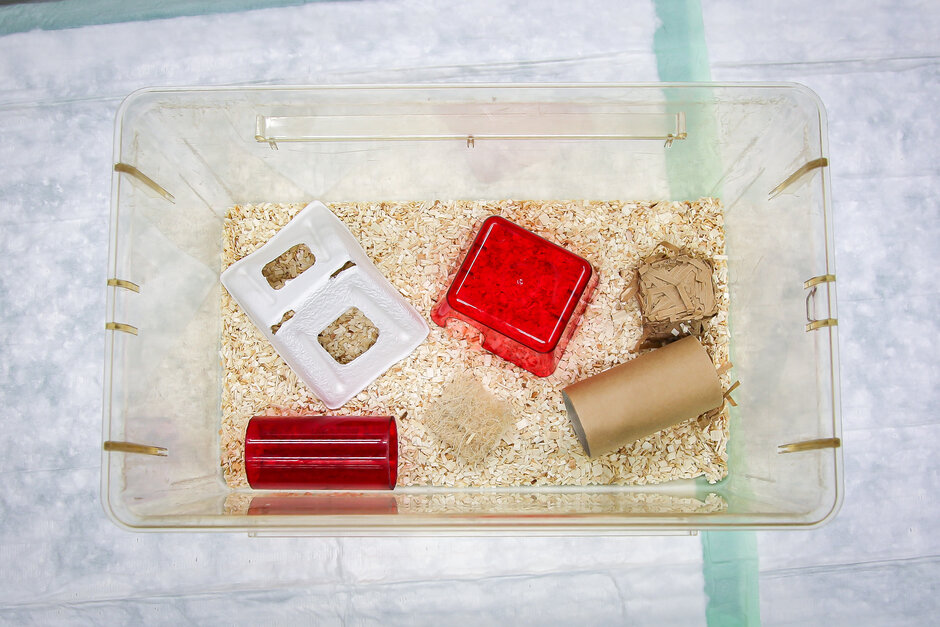 Foto: UR
Rehome
In addition to the actual 3Rs, there are other "Rs", e.g. rehoming. Rehoming is the transfer of healthy animals from an animal laboratory to private ownership. Many people are familiar with this from the so-called "lab beagles", but rodents can also be rehomed. However, it should be noted that European legislation only allows genetically unmodified animals to be handed over, which means that the majority of mice and rats kept in our country are not eligible for this. When adopting an animal from a laboratory, there are a number of things that need to be taken into account to ensure that the animal is well acclimatised to its new home, which is why we only hand over our animals with a protection contract and after presenting pictures of the new home. For the purpose of animal welfare, we also cooperate with the Straubing animal shelter (external link, opens in a new window) (German version only).
We do not always have animals available, but if you would be willing to take in mice or rats, please contact us at ztl(at)ur.de (opens your email program). We will be happy to put you on our waiting list!