

The 2026 winners
Curriculum category
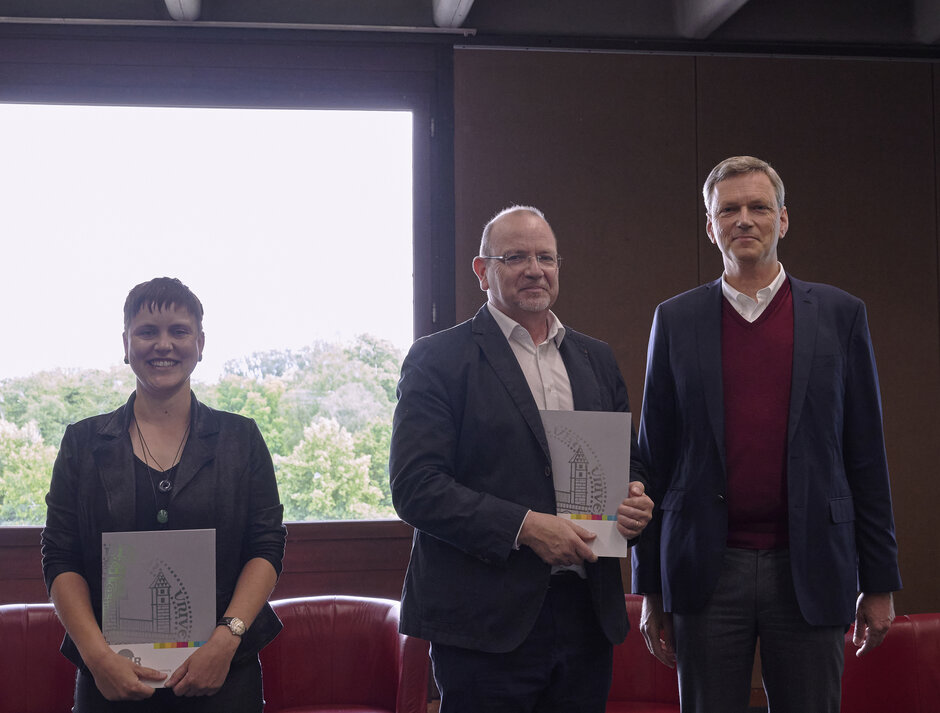
The Bachelor’s degree programme Liberal Arts: Culture, History, Society received the award for the best innovation in the curriculum category. Responsible for its implementation are Prof. Dr. Rainer Liedtke (Chair of European History (19th and 20th centuries)) and Gabriela Dafinger, M.A. (programme coordinator B.A. Liberal Arts & M.A. European Studies). They were supported by further colleagues.
The programme builds on a long humanistic tradition and aims at broad education, critical thinking and personal development. Taught entirely in English, it closely interweaves history, cultural and literary studies and the social sciences.
Further information on the Liberal Arts: Culture, History, Society programme can be found here (opens in a new window). (This PDF is not accessible).
Course category
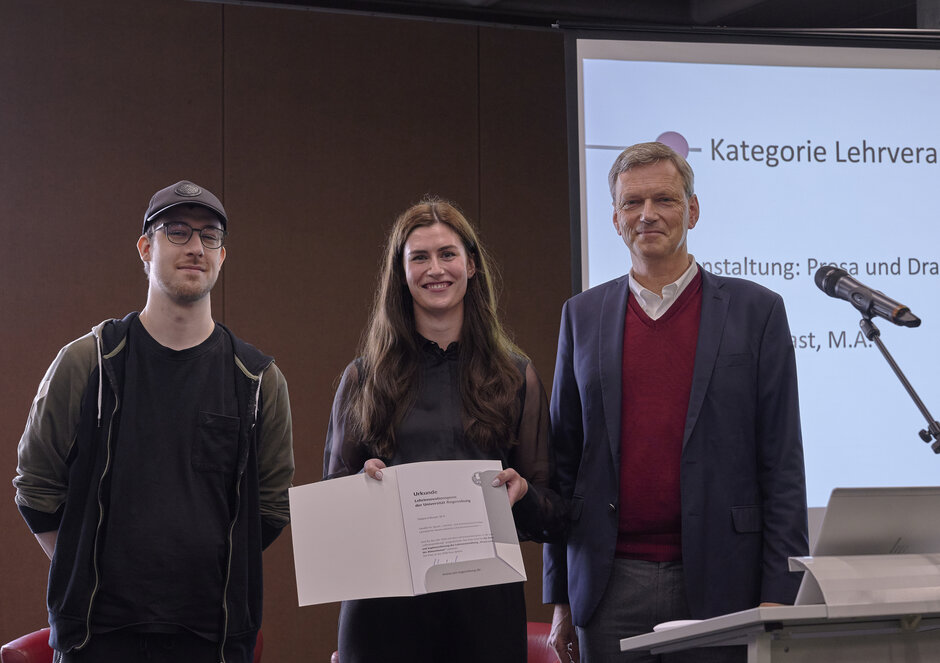
The advanced seminar „Prosa und Dramen des Naturalismus“ by Tatjana Kühnast, M.A. (research assistant at the Chair of Modern German Literature 1) in the field of literary studies was honoured as the best course.
The seminar combines digital text annotation with sustainable documentation of results (course bingo, recap posts) and interactive seminar formats to form a coherent overall concept. Using the annotation website text.ur, developed in-house, students can read, highlight and comment on texts along predefined lines of research. text.ur (external link, opens in a new window) is available free of charge to all teaching staff at the University of Regensburg. Tatjana Kühnast received technical support from Fabian Schebera.
A detailed description of the course can be found here (opens in a new window). (This PDF is not accessible).
Assessment category
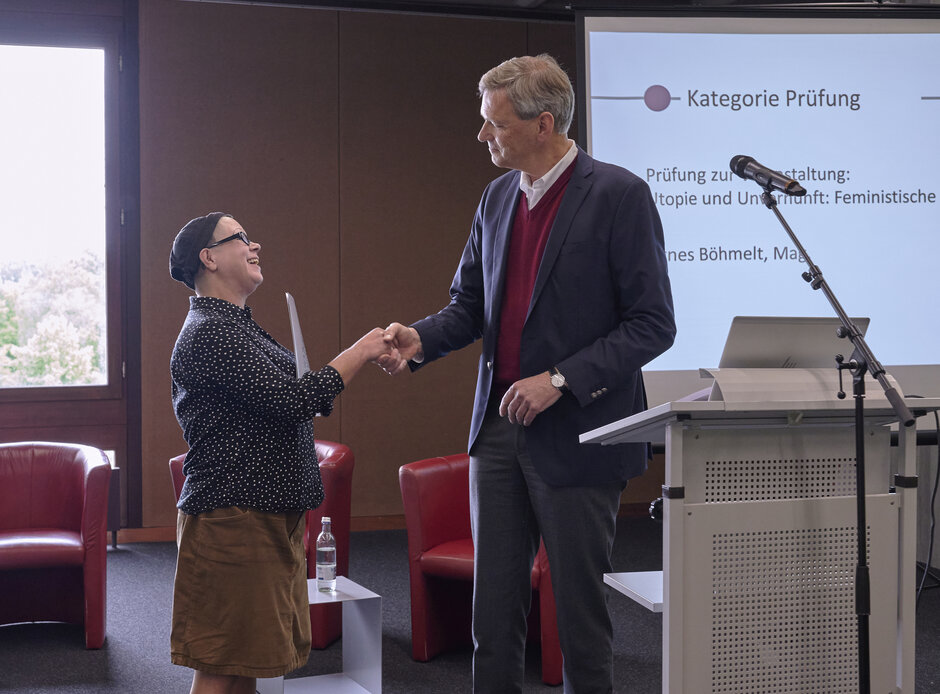
The Teaching Innovation Award in the assessment category went to Agnes Böhmelt, Mag. (lecturer at the Professorship for Dynamics of Virtual Communication Spaces) for the design and implementation of the assessment format in the seminar „Utopie und Unvernunft: Feministische Manifeste“.
In the seminar, students first explored feminist manifestos and were then tasked with writing a manifesto of their own. This had to be either designed graphically or staged as a performance. Many of the manifestos produced in the seminar were presented at the university in a specially curated exhibition (external link, opens in a new window).
Among other things, the assessment design aims to take account of a heterogeneous student body. The seminar is part of the interdisciplinary supplementary programme Zusatzstudium Genderkompetenz, offered jointly by the University of Regensburg and OTH Regensburg. A detailed description of the supplementary programme can be found here (external link, opens in a new window).
Winning projects 2025
Curriculum category
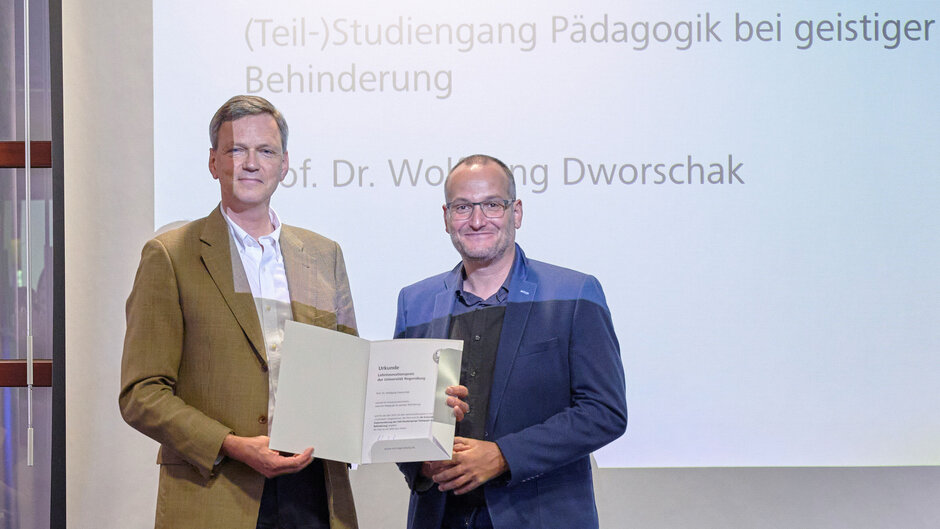
The (partial) degree programme Pädagogik bei geistiger Behinderung received the award for the best innovation in the curriculum category. Responsible for its implementation are Professor Dr. Wolfgang Dworschak and his team (Chair of Education for People with Intellectual Disabilities including Inclusive Education).
The programme aims to prepare student teachers comprehensively and in a competence-oriented way for everyday teaching. Its design focuses on closely linking theory with practice as well as theory with research.
An overview of the structure of the programme can be found here (opens in a new window). (This PDF is not accessible).
Course category
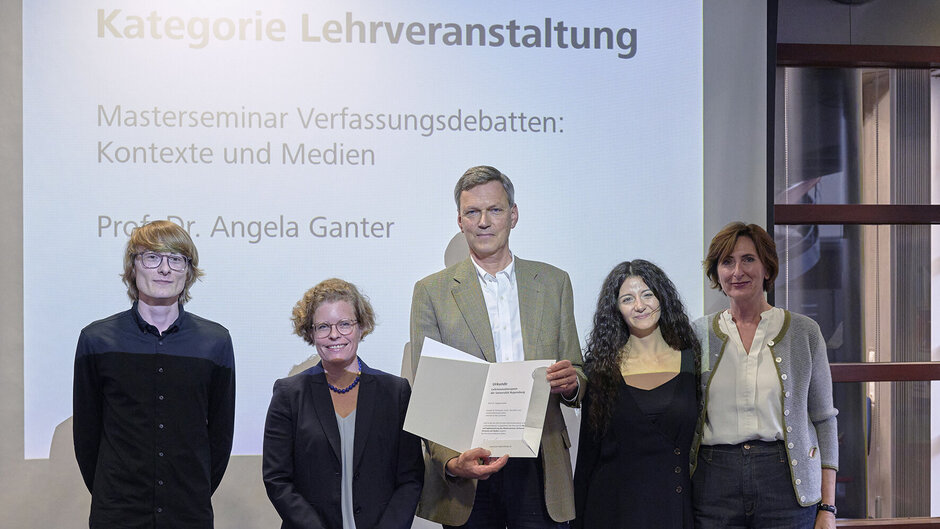
The master’s seminar „Verfassungsdebatten: Kontexte und Medien“ by Professor Dr. Angela Ganter (Chair of Ancient History) was honoured as the best course.
The seminar’s first objective was to place ancient debates handed down as texts in their contemporary historical horizons. It combines the study of ancient texts and topics and embeds debates in their everyday contexts. Students take an active role and develop their own podcast contributions in groups, in which they engage with constitutional debates in antiquity.
A detailed description of the course can be found here (opens in a new window). (This PDF is not accessible).
Assessment category
The Teaching Innovation Award in the assessment category was granted for the introduction of the Objective Structured Clinical Examination (OSCE) on the classification and handling of dental ceramics in the field of medicine.
Those involved in its design and implementation are Dr. Laura Haas, Prof. Dr. Martin Rosentritt, Prof. Dr. Sebastian Hahnel and PD Dr. Angelika Rauch, M.Sc. from the Department of Prosthetic Dentistry at Regensburg University Hospital.
The OSCE examination format tests practical competences. It consists of three stations at which both knowledge and practical skills are assessed. The examiners are given special instructions beforehand. During the examination, students receive a record sheet so that they can keep track of the results they have achieved.
A detailed description of the examination structure can be found here (opens in a new window). (This PDF is not accessible).

Winning projects 2024
Curriculum category
The extension programme Medienpädagogik für alle Lehrämter received the award for the best innovation in the curriculum category. Responsible for its implementation are Professor Dr. Silke Schworm and Akademische Rätin Martina Rasp. The programme addresses the growing relevance of digital media in education.
Its aim is to prepare student teachers comprehensively for digital teaching. Alongside media education and media didactics, it also conveys practical IT skills.
An overview of the structure of the programme can be found here (opens in a new window). (This PDF is not accessible). Contact details and further information are also available on the programme’s website.
The following video shows examples from various courses in the programme.
Course category
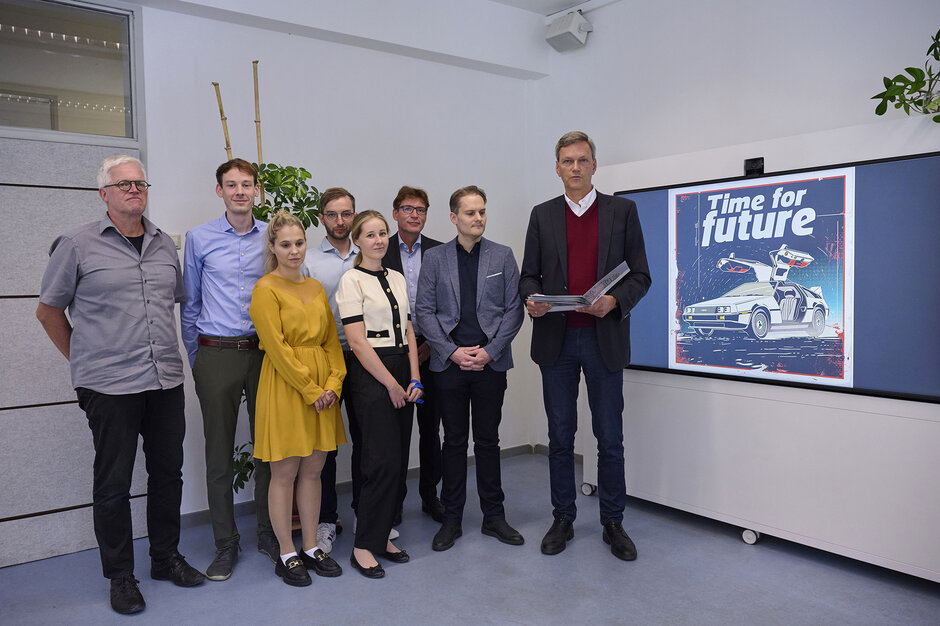
The smartphone-based microsurgery course in human medicine (Department of Plastic, Hand and Reconstructive Surgery) was honoured as the best course.
The award winners come from various disciplines and are led by Prof. Dr. Silvan Klein (UKR). The other team members honoured are: Kerstin Steer, Prof. Dr. Alexandra Anker, Andreas Eigenberger, Dr. Andreas Siegmund, Dr. Stephan Giglberger, Prof. Dr. Thomas Schratzenstaller, Jasmin Lenhard, Prof. Dr. Dr. Lukas Prantl and Dr. Marc Rüwe.
The Centre for Plastic, Hand and Reconstructive Surgery combines smartphone technology with 3D-printed training phantoms in order to offer students practical and low-cost learning opportunities.
Until now, the high cost and limited availability of surgical microscopes have been major obstacles to teaching students microsurgical techniques in a practical setting. This innovation allows students to learn surgical techniques hands-on for the first time without depending on expensive specialist equipment. The smartphone magnification function and the 3D models provide a realistic simulation of microsurgical procedures, which significantly raises the standard of training and is intended to secure urgently needed new talent for the field.
Assessment category
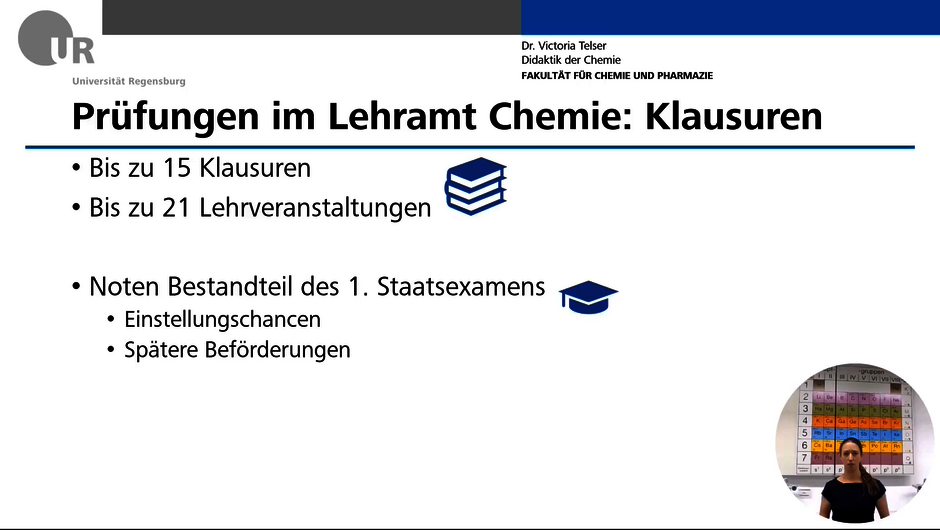
The Teaching Innovation Award in the assessment category was granted for the reform of the examination arrangements in the subject of chemistry for all teaching degrees.
Those involved were Dr. Victoria Telser, Prof. Dr. Oliver Tepner, Dr. Claudia Wanninger-Weiß, Prof. Dr. Dominik Horinek and Prof. Dr. Patrick Nürnberger.
The reform came into force in October 2023 and is characterised by considerably greater flexibility in examinations. The following video explains the changes in more detail.
Contact
Dr. Linda Puppe
Innovation Hub
- E-mail address: linda.puppe(at)ur.de (opens your email program)
- Tel: 0941 943-5343 (starts a telephone call, if your device allows this)
- Location: Altes Finanzamt, Room 233
The Teaching Innovation Award is funded from resources of the Hochschulvertrag 2023 - 2027 (external link, opens in a new window).