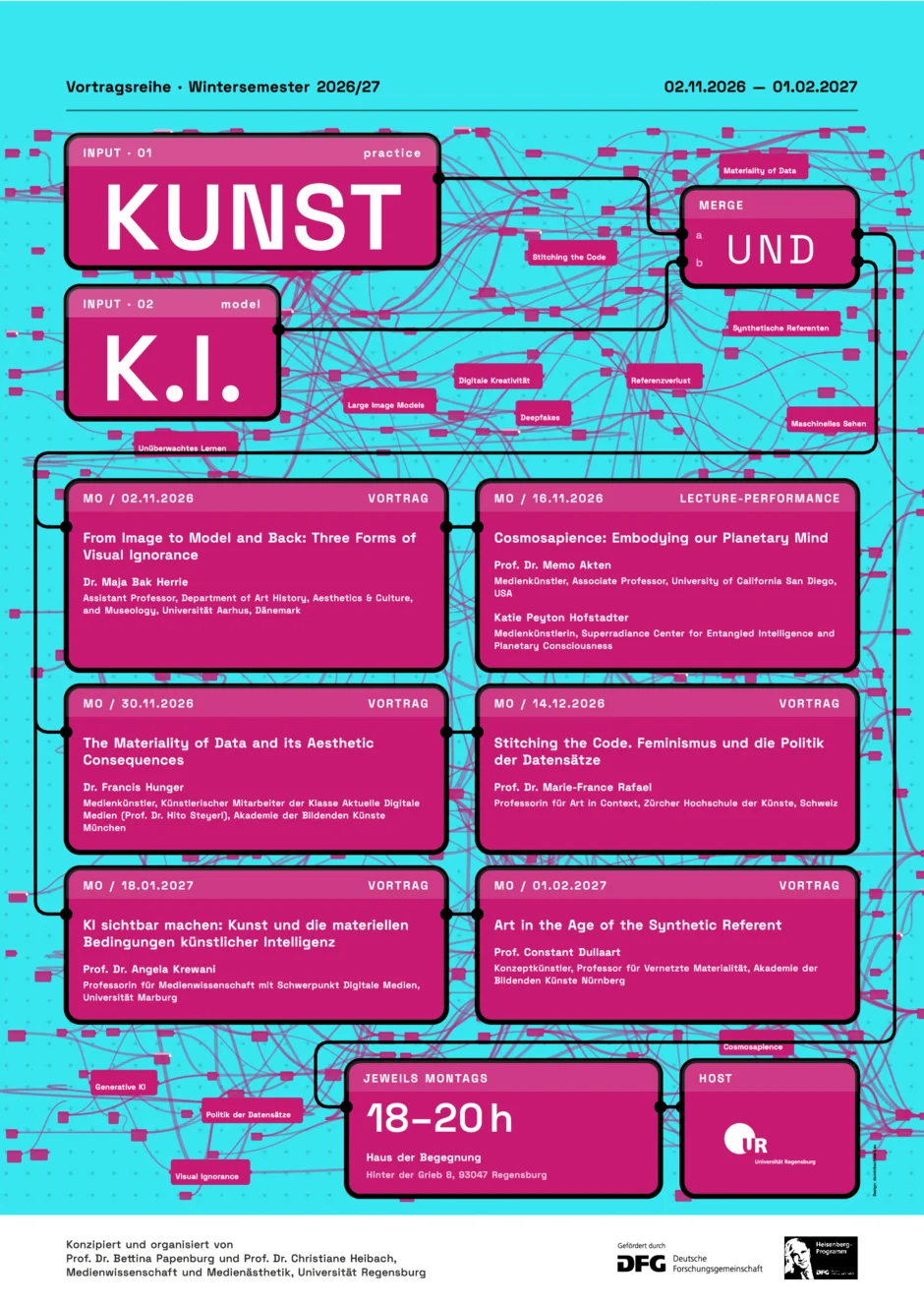
In der Vortragsreihe „Kunst und KI“ setzen renommierte Kolleg:innen aus der Medienwissenschaft und angrenzenden Fachgebieten sowie Künstler:innen aus dem Bereich der Medienkunst Impulse zum KI-Diskurs. Die Reihe verfolgt drei Ziele: Zum Ersten ordnen die Vorträge aktuelle künstlerische Arbeiten, die Künstliche Neuronale Netze einbeziehen, in einen Entwicklungsprozess ein, um die verbreitete Annahme, bei KI handele es sich um etwas Einzigartiges und Noch-Nie-Dagewesenes, zu hinterfragen. Zum Zweiten geht die Reihe der Frage nach, wie künstlerische Arbeiten das Zusammenwirken menschlicher und nicht-menschlicher Akteure in der Arbeit mit Datensätzen und Algorithmen reflexiv ausgestalten. Und zum Dritten diskutieren wir projektive und alternative Praktiken des Maschinellen Lernens und Formen des praktischen Wissens, die in der Kunst erprobt werden, um neue kritische Ansätze und Methoden zu entwickeln und auf diese Weise andere Wege für einen Umgang mit KI aufzuzeigen.
Ort: Universität Regensburg, Haus der Begegnung, Hinter der Grieb 8, 93047 Regensburg
Vortragstermine: 2. November 2026, 16. November 2026, 30. November 2026, 14. Dezember 2026, 18. Januar 2027, 1. Februar 2027, jeweils 18 bis 20 Uhr
Konzeption und Organisation: Prof. Dr. Bettina Papenburg, Medienwissenschaft / Prof. Dr. Christiane Heibach, Medienästhetik
entfällt !! 02. November 2026
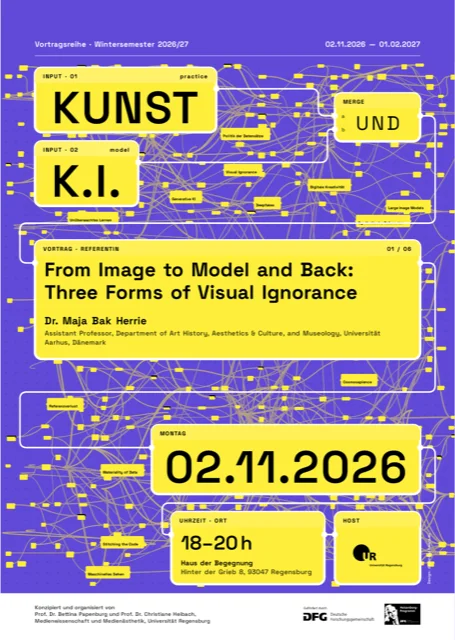
Maja Bak Herrie (Universität Aarhus)
From Image to Model and Back: Three Forms of Visual Ignorance
Abstract
As AI-generated content increasingly shape how we encounter and interpret the world, the boundaries between knowledge and ignorance are becoming an important site of contestation. But how is ignorance produced, and what role does aesthetics play in this process? Drawing on agnotology, the study of the deliberate production of ignorance, this lecture examines how images and the institutions and systems through which they are produced, organised, and interpreted shape what can be known. It explores these questions through three contemporary artistic projects.
In Ancestral Seeds (2020), Nouf Aljowaysir engages with colonial photographic archives; in ماه طلعت (Moon-faced) (2022), Morehshin Allahyari reimagines Qajar portraiture; and in The Post-Truth Museum (2021–23), Nora Al-Badri uses deepfakes to address cultural heritage and institutional authority. Through these projects, I propose visual ignorance as a concept for examining how ignorance is produced, negotiated, and given visual form, particularly in relation to historical erasure and the authority to interpret cultural images.
Moving from image to model and back, the lecture considers how visual ignorance takes shape across different contexts, from the datasets that inform machine learning and image generation to the institutions that preserve and interpret cultural heritage. It asks how ignorance can be understood not simply as an absence of knowledge, but as something actively produced and expressed through aesthetic forms.
Bio
Maja Bak Herrie is Assistant Professor at Department of Art History, Aesthetics and Culture and Museology at Aarhus University. She works at the intersection of aesthetics, media theory, and theories of knowledge, exploring computational imaging, technologies of vision, photography, and artistic research. Her work investigates how images, data, and technologies shape perception, including in her monograph Thinking Through Data: How Outliers, Aggregates, and Patterns Shape Perception (Stanford University Press, 2025). She is co-founder of AIIM: Centre for Aesthetics of AI Images, and co-editor of The Nordic Journal of Aesthetics.
16. November 2026
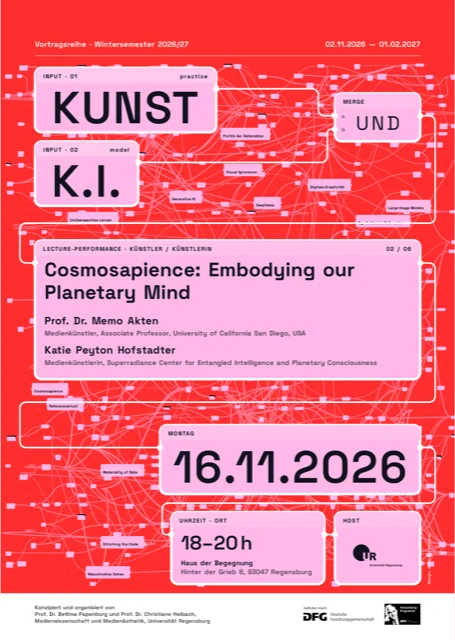
Memo Akten (University of California San Diego) / Katie Peyton Hofstadter (Superradiance Center for Entangled Intelligence and Planetary Consciousness)
Cosmosapience: Embodying our Planetary Mind
Abstract
Beginning with the body as a porous collaboration of cells, microbes,
matter and environment, this performance-lecture moves through cephalopods,
symbiotic bacteria, ant colonies, language, computation, oceans and
planetary systems, tracing intelligence across scales and beyond the
boundaries of the individual.
Weaving together ancient biotechnologies like poetry, dance, and ritual
with artificial intelligence, simulations, and generative systems, Memo
Akten & Katie Hofstadter explore what our technologically mediated culture
has severed us from, and what happens when the abstractions we use to make
the world legible are mistaken for reality itself. The world is full of
communication, and it is not all meant for us. Yet it affects us in ways
far beyond what our simple models can comprehend and far beyond the reach
of machine metaphors and computational frameworks.
The performance-lecture moves from the dense webs of feedback loops through
which bodies, minds and planetary systems emerge, to the massive
superorganism arising from billions of local actions and disrupting those
cycles. It asks what it means to have developed planetary power without a
planetary sense of self, and how art might help metabolize intellectual
knowledge into felt experience.
Bio
Memo Akten & Katie Hofstadter are California based interdisciplinary artists and researchers, whose work investigates the entanglements of technology, embodiment, consciousness, andculture. Merging backgrounds in dance, writing, poetry, drawing, sculpture, computer science, artificial intelligence, computational art, and public practice, they create speculative simulations, data dramatizations, immersive installations, and narrative experiments that probe the human condition in an age of artificial intelligence and accelerating transformation.
Memo Akten is an artist, researcher, and computer scientist working with emerging technologies both as creative medium and as subject of critical inquiry. He creates Speculative Simulations and Data Dramatizations that probe the cultural, social and ecological impacts of our contemporary techno-lifestyles, and the collisions between science and spirituality, modernity and ritual, self and collective intelligence. His practice spans moving image, sound, language, dance, installation and performance, often employing algorithmic, data-driven, and interactive processes. He holds a PhD in Artificial Intelligence and Computational Art from Goldsmiths, University of London, and is Associate Professor at UC San Diego. He has exhibited and performed internationally and received numerous awards including the Prix Ars Electronica Golden Nica.
Katie Hofstadter is a multidisciplinary artist, writer, and curator whose work investigates the complex relationships between embodiment, consciousness, and technologically mediated imagination. Through her diverse practice, she explores the dynamics between knowing and feeling, and examines how emerging technologies shape both cultural narratives and direct experience. She is co-founder of several global public art campaigns such as the ARORA network, bringing together over 70 artists creating new AR monuments to diverse female and gender-expansive voices in public spaces; and the Climate Clock in NYC, a global call to #actintime on the climate crisis. Her work has been exhibited internationally at galleries, museums, festivals, and public institutions, including the Venice Biennale, Tribeca Film Festival, British Film Festival, and Jacob’s Pillow. Her work has been covered by major media outlets such as the New York Times, Los Angeles Times, The San Diego Union-Tribune, The Washington Post, and Smithsonian Magazine. Her writing appears in leading arts and literary publications including Flash Art, The Believer, BOMB, The Bulletin of Atomic Scientists, and Right Click Save. Together, their collaborative research and practice explore how emerging technologies—particularly AI and data systems—interact with the embodied, emotional, and ecological dimensions of human experience.
30. November 2026
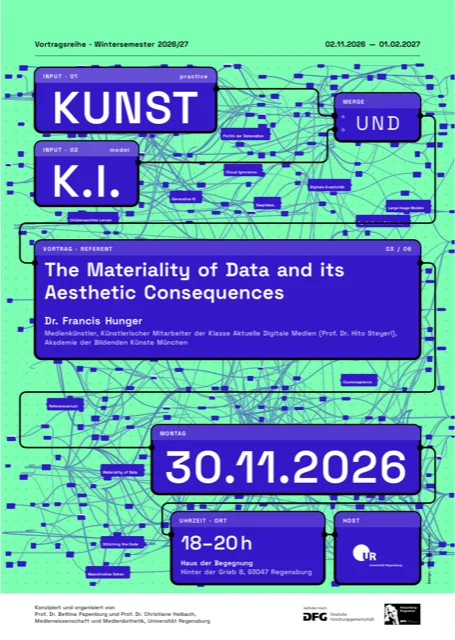
Francis Hunger (Akademie der Bildenden Künste München)
The Materiality of Data and its Aesthetic Consequences
Abstract
Databases have become central to organizing data and the processes of everyday human life. They are at the core of all software, and a look at database practices allows media theory to readjust its conceptual understanding of computing from ‘algorithms’ or ‘machines’ towards ‘data practices’. Databases are “media of cooperation” (Schüttpelz) and, as such, central to the data materialities of primary data, transactional data, and analytical data. These three materialities are organized around a structuralist paradigm of world-making that puts data into a formation to become in-formation (Krajewski). In contrast to these structured data materialities stands the probabilistic, synthetic approach of so-called ‘neural’ networks in so-called Artificial Intelligence, which produces a different data materiality: derivative data. The lecture covers these materialities and suggests their aesthetic consequences.
Bio
Dr. Francis Hunger ist Künstler und Theoretiker und setzt sich mit der Geschichte der Technologie als Ausdruck von Machtkonstellationen auseinander. Derzeit ist er Hochschullehrer für Aktuelle Digitale Medien an der Akademie der bildenden Künste, München und Co-Editor der Onlinepublikation Carrier-Bag.net. In diesem Rahmen co-organisierte er u.a. auch die Konferenzen Decoherence (2026), Art in the Age of Average (2025), Dronomation (2024) und If AI was the answer, what was the question again? (2024).
Er forscht über Europäische Datenbanken als PostDoc im Projekt Dataunion an der VUB, Brüssel. 2021–23 war Francis Hunger wissenschaftlicher Mitarbeiter im Projekt Training The Archive am Hartware MedienKunstVerein, Dortmund, und am Ludwig Forum Aachen, wo er den Einsatz von KI, Statistik und Mustererkennung für Kunst und Kuratieren kritisch untersuchte.
Seine Dissertation zu Operationalitäten und Genealogien relationaler Datenbanken mündet in das Buch Running the Data World – A media theory of the relational database, welches 2027 bei Minnesota University Press erscheint.
14. Dezember 2026
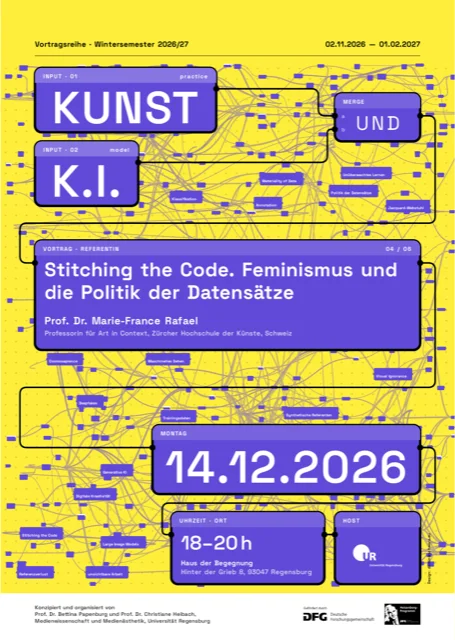
Marie-France Rafael (Zürcher Hochschule der Künste)
Stitching the Code. Feminismus und die Politik der Datensätze
18. Januar 2027
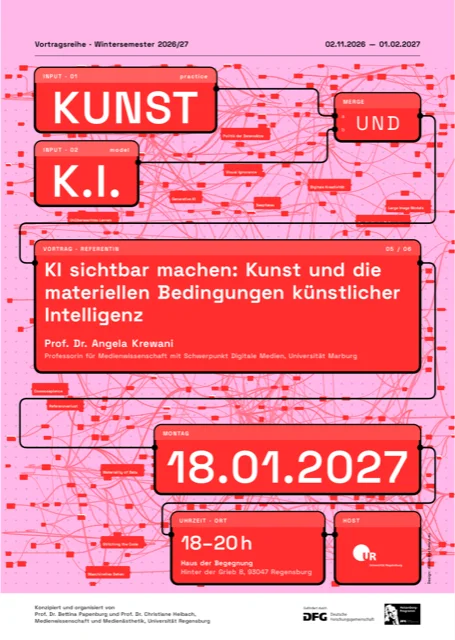
Angela Krewani (Philipps-Universität Marburg)
KI sichtbar machen: Kunst und die materiellen Bedingungen künstlicher Intelligenz
Abstract
Die gegenwärtige Debatte über das Verhältnis von Kunst und Künstlicher Intelligenz konzentriert sich vornehmlich auf Fragen der Kreativität, der Autorschaft und der ästhetischen Möglichkeiten generativer Bildproduktion. Dabei geraten die materiellen, sozialen und technischen Bedingungen, unter denen KI-Systeme operieren, häufig aus dem Blick. Der Vortrag schlägt deshalb einen Perspektivwechsel vor: Anstelle der ästhetischen Ergebnisse KI-gestützter Bildproduktion rücken die medienökologischen Voraussetzungen Künstlicher Intelligenz und deren künstlerische Reflexion in den Mittelpunkt.
Ausgehend von Kate Crawfords Atlas of AI wird Künstliche Intelligenz als ein komplexes Gefüge materieller Infrastrukturen, menschlicher Arbeit, technologischer Prozesse und politischer Machtverhältnisse verstanden. Diese Perspektive widerspricht der Vorstellung von KI als einer weitgehend autonomen, immateriellen Technologie und richtet die Aufmerksamkeit auf Ressourcenverbrauch, Dateninfrastrukturen, unsichtbare Arbeitsprozesse und postkoloniale Abhängigkeitsverhältnisse.
Anhand ausgewählter zeitgenössischer Kunstwerke, unter anderem aus dem Kontext der Ars Electronica, untersucht der Vortrag, wie künstlerische Praktiken diese häufig unsichtbaren Bedingungen Künstlicher Intelligenz aufgreifen, transformieren und ästhetisch erfahrbar machen. Dabei stehen weniger die technischen Verfahren der KI-basierten Kunstproduktion als vielmehr jene künstlerischen Arbeiten im Vordergrund, die KI selbst zum Gegenstand kritischer Auseinandersetzung machen.
Die zentrale These lautet, dass eine medienökologisch orientierte Kunst einen eigenständigen epistemischen und ästhetischen Reflexionsraum eröffnet. Während wissenschaftliche und journalistische Diskurse die gesellschaftlichen und ökologischen Bedingungen von KI vornehmlich beschreiben und analysieren, können künstlerische Verfahren diese Bedingungen in spezifischer Weise visualisieren, materialisieren und sinnlich erfahrbar machen. Kunst wird damit nicht lediglich zum Medium der Illustration bereits vorhandener Kritik, sondern zu einer eigenständigen Form der Wissensproduktion über Künstliche Intelligenz.
Bio
Seit 2003 Professorin für Medienwissenschaft an der Philipps-Universität Marburg. Studierte Anglistik, Anglo-Amerikanische Geschichte und Politikwissenschaft an der Universität zu Köln. Dissertation 1992 an der Universität Siegen im Fach Anglistik; Habilitation 1999 zum Thema Hybride Formen- New British Cinema – Television Drama – Hypermedia. 2006-2007 Fellow am Zentrum für interdisziplinäre Forschung, Bielefeld. 2008 Gastprofessur am Brooklyn College, New York. Forschungsschwerpunkte sind digitale Medien und ihre Theorien, Medienkunst, KI und Verschwörungsnarrative in Sozialen Medien. 2016 legte sie eine Monographie zu Medienkunst. Theorie - Praxis - Ästhetik vor. Aktuelle Herausgeberschaften: Mit Christiane Heibach und Irene Schütze, Constructions of Media Authorship, 2021, mit Alena Strohmaier Media and Mapping Practices in the Middle East and North Africa, 2021. Ihre jüngste Publikation gemeinsam mit Peter Zimmermann arbeitet die Medialisierung der Covid-19 Pandemie auf: Das Virus im Netz medialer Diskurse. Zur Rolle der Medien in der Corona-Krise, 2022. Aktuell arbeitet sie an einer Publikation zu den visuellen Kulturen von Verschwörungstheorien, die 2027 bei Central European University Press erscheinen wird.
01. Februar 2027
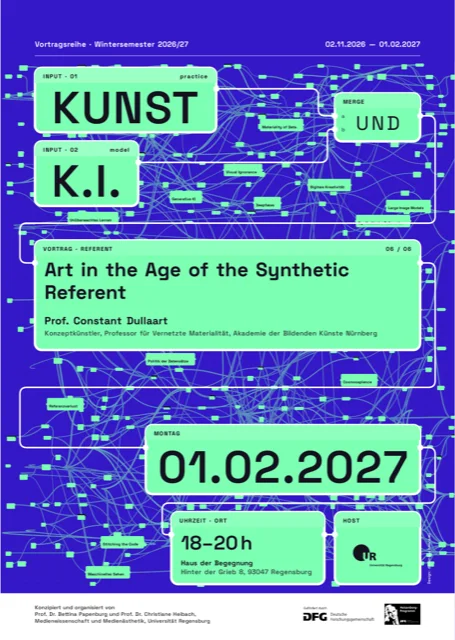
Constant Dullaart (Akademie der Bildenden Künste Nürnberg)
Art in the Age of Synthetic Referent
Programm