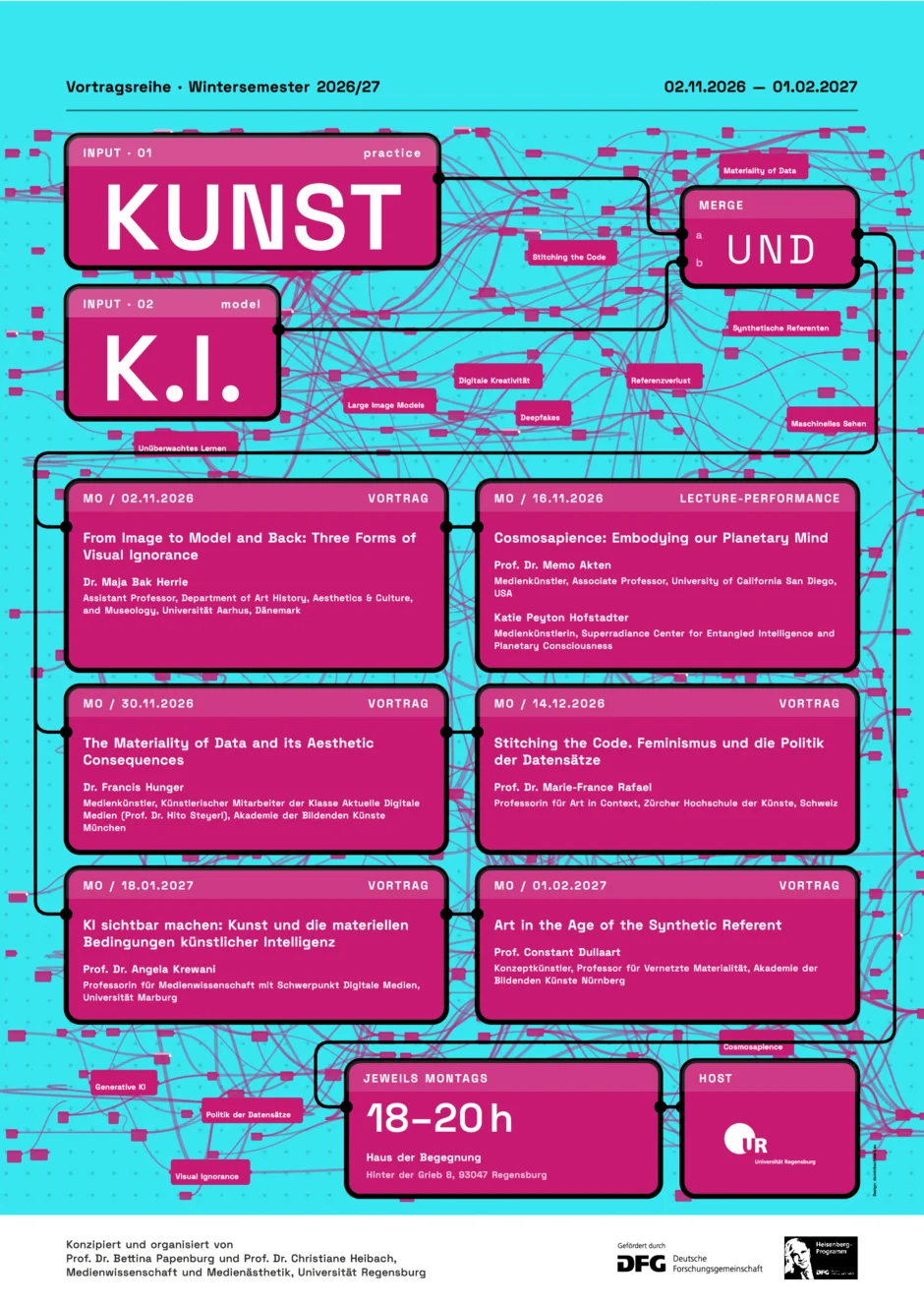
In the lecture series ‘Art and AI’, renowned academics from media studies and related disciplines, as well as artists working in the field of media art, contribute fresh perspectives to the discourse on AI. The series pursues three objectives: Firstly, the lectures situate current artistic works that incorporate artificial neural networks within a developmental process, in order to challenge the widespread assumption that AI is something unique and unprecedented. Secondly, the series explores how artistic works reflexively shape the interaction between human and non-human actors when working with datasets and algorithms. And thirdly, we discuss projective and alternative practices of machine learning and forms of practical knowledge that are being explored in art, with a view to developing new critical approaches and methods and, in this way, highlighting alternative ways of engaging with AI.
Venue: University of Regensburg, Haus der Begegnung, Hinter der Grieb 8, 93047 Regensburg
Lecture dates: 2 November 2026, 16 November 2026, 30 November 2026, 14 December 2026, 18 January 2027, 1 February 2027, 6.00–8.00 pm
Concept and organisation: Prof. Dr Bettina Papenburg, Media Studies / Prof. Dr Christiane Heibach, Media Aesthetics
2 November 2026
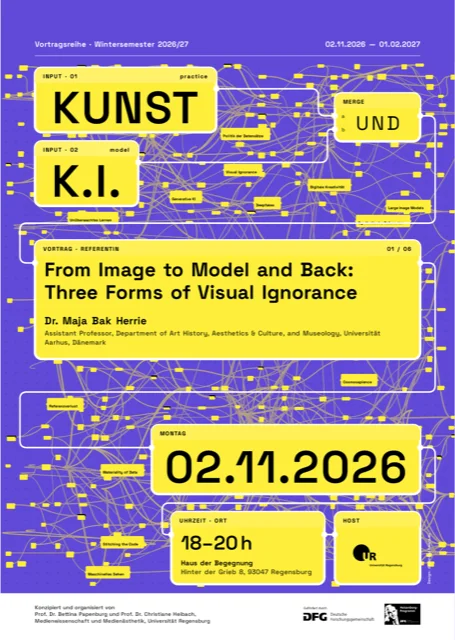
Maja Bak Herrie (Aarhus University)
From Image to Model and Back: Three Forms of Visual Ignorance
Abstract
As AI-generated content increasingly shapes how we encounter and interpret the world, the boundaries between knowledge and ignorance are becoming a key area of contention. But how is ignorance produced, and what role does aesthetics play in this process? Drawing on agnotology – the study of the deliberate production of ignorance – this lecture examines how images, and the institutions and systems through which they are produced, organised and interpreted, shape what can be known. It explores these questions through three contemporary artistic projects.
In *Ancestral Seeds* (2020), Nouf Aljowaysir engages with colonial photographic archives; in *ماه طلعت* (*Moon-faced*) (2022), Morehshin Allahyari reimagines Qajar portraiture; and in The Post-Truth Museum (2021–23), Nora Al-Badri uses deepfakes to address cultural heritage and institutional authority. Through these projects, I propose ‘visual ignorance’ as a concept for examining how ignorance is produced, negotiated and given visual form, particularly in relation to historical erasure and the authority to interpret cultural images.
Moving from image to model and back, the lecture considers how visual ignorance takes shape across different contexts, from the datasets that inform machine learning and image generation to the institutions that preserve and interpret cultural heritage. It asks how ignorance can be understood not simply as an absence of knowledge, but as something actively produced and expressed through aesthetic forms.
Bio
Maja Bak Herrie is an Assistant Professor in the Department of Art History, Aesthetics and Culture and Museology at Aarhus University. She works at the intersection of aesthetics, media theory and theories of knowledge, exploring computational imaging, technologies of vision, photography and artistic research. Her work investigates how images, data and technologies shape perception, as explored in her monograph *Thinking Through Data: How Outliers, Aggregates, and Patterns Shape Perception* (Stanford University Press, 2025). She is co-founder of AIIM: Centre for Aesthetics of AI Images, and co-editor of *The Nordic Journal of Aesthetics*.
16 November 2026
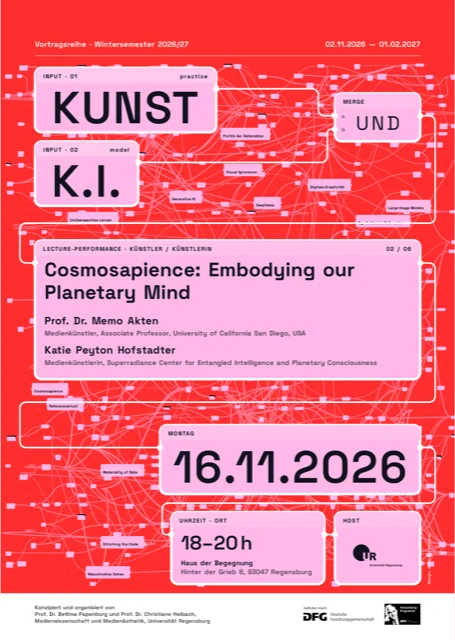
Memo Akten (University of California, San Diego) / Katie Peyton Hofstadter (Superradiance Centre for Entangled Intelligence and Planetary Consciousness)
Cosmosapience: Embodying our Planetary Mind
Beginning with the body as a porous collaboration of cells, microbes,
matter and environment, this performance-lecture moves through cephalopods,
symbiotic bacteria, ant colonies, language, computation, oceans and
planetary systems, tracing intelligence across scales and beyond the
boundaries of the individual.
Weaving together ancient biotechnologies like poetry, dance, and ritual
with artificial intelligence, simulations, and generative systems, Memo
Akten & Katie Hofstadter explore what our technologically mediated culture
has severed us from, and what happens when the abstractions we use to make
the world legible are mistaken for reality itself. The world is full of
communication, and it is not all meant for us. Yet it affects us in ways
far beyond what our simple models can comprehend and far beyond the reach
of machine metaphors and computational frameworks.
The performance-lecture moves from the dense webs of feedback loops through
which bodies, minds and planetary systems emerge, to the massive
superorganism arising from billions of local actions and disrupting those
cycles. It asks what it means to have developed planetary power without a
planetary sense of self, and how art might help metabolize intellectual
knowledge into felt experience.
Bio
Memo Akten & Katie Hofstadter are California based interdisciplinary artists and researchers, whose work investigates the entanglements of technology, embodiment, consciousness, andculture. Merging backgrounds in dance, writing, poetry, drawing, sculpture, computer science, artificial intelligence, computational art, and public practice, they create speculative simulations, data dramatizations, immersive installations, and narrative experiments that probe the human condition in an age of artificial intelligence and accelerating transformation.
Memo Akten is an artist, researcher, and computer scientist working with emerging technologies both as creative medium and as subject of critical inquiry. He creates Speculative Simulations and Data Dramatizations that probe the cultural, social and ecological impacts of our contemporary techno-lifestyles, and the collisions between science and spirituality, modernity and ritual, self and collective intelligence. His practice spans moving image, sound, language, dance, installation and performance, often employing algorithmic, data-driven, and interactive processes. He holds a PhD in Artificial Intelligence and Computational Art from Goldsmiths, University of London, and is Associate Professor at UC San Diego. He has exhibited and performed internationally and received numerous awards including the Prix Ars Electronica Golden Nica.
Katie Hofstadter is a multidisciplinary artist, writer, and curator whose work investigates the complex relationships between embodiment, consciousness, and technologically mediated imagination. Through her diverse practice, she explores the dynamics between knowing and feeling, and examines how emerging technologies shape both cultural narratives and direct experience. She is co-founder of several global public art campaigns such as the ARORA network, bringing together over 70 artists creating new AR monuments to diverse female and gender-expansive voices in public spaces; and the Climate Clock in NYC, a global call to #actintime on the climate crisis. Her work has been exhibited internationally at galleries, museums, festivals, and public institutions, including the Venice Biennale, Tribeca Film Festival, British Film Festival, and Jacob’s Pillow. Her work has been covered by major media outlets such as the New York Times, Los Angeles Times, The San Diego Union-Tribune, The Washington Post, and Smithsonian Magazine. Her writing appears in leading arts and literary publications including Flash Art, The Believer, BOMB, The Bulletin of Atomic Scientists, and Right Click Save. Together, their collaborative research and practice explore how emerging technologies—particularly AI and data systems—interact with the embodied, emotional, and ecological dimensions of human experience.
30 November 2026
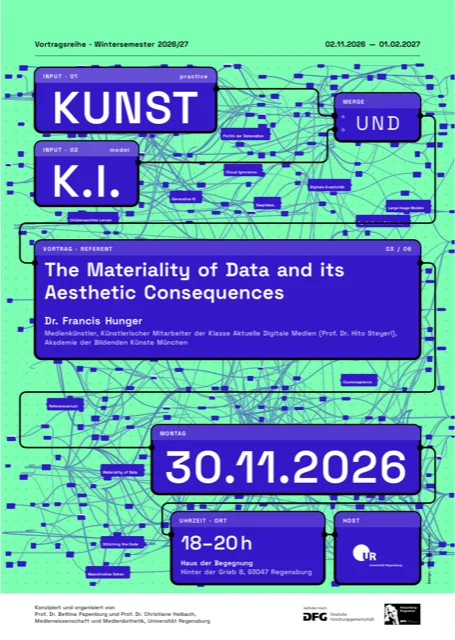
Francis Hunger (Academy of Fine Arts, Munich)
The Materiality of Data and its Aesthetic Consequences
Abstract
Databases have become central to the organisation of data and the processes of everyday human life. They lie at the heart of all software, and an examination of database practices enables media theory to realign its conceptual understanding of computing from ‘algorithms’ or ‘machines’ towards ‘data practices’. Databases are “media of cooperation” (Schüttpelz) and, as such, central to the data materialities of primary data, transactional data and analytical data. These three materialities are organised around a structuralist paradigm of world-making that arranges data into a formation to become in-formation (Krajewski). In contrast to these structured data materialities stands the probabilistic, synthetic approach of so-called ‘neural’ networks in so-called Artificial Intelligence, which produces a different data materiality: derivative data. The lecture explores these materialities and suggests their aesthetic implications.
Bio
Dr. Francis Hunger is an artist and theorist who explores the history of technology as an expression of power dynamics. He is currently a professor of Contemporary Digital Media at the Academy of Fine Arts in Munich and co-editor of the online publication Carrier-Bag.net. In this capacity, he has co-organized conferences including Decoherence (2026), Art in the Age of Average (2025), Dronomation (2024), and “If AI Was the Answer, What Was the Question Again?” (2024).
He is conducting research on European databases as a postdoctoral fellow in the Dataunion project at VUB in Brussels. From 2021 to 2023, Francis Hunger was a research associate in the Training The Archive project at the Hartware MedienKunstVerein in Dortmund and at the Ludwig Forum Aachen, where he critically examined the use of AI, statistics, and pattern recognition in art and curation.
His dissertation on the operationalities and genealogies of relational databases will be published as the book Running the Data World – A Media Theory of the Relational Database, to be released in 2027 by the University of Minnesota Press.
14 December 2026
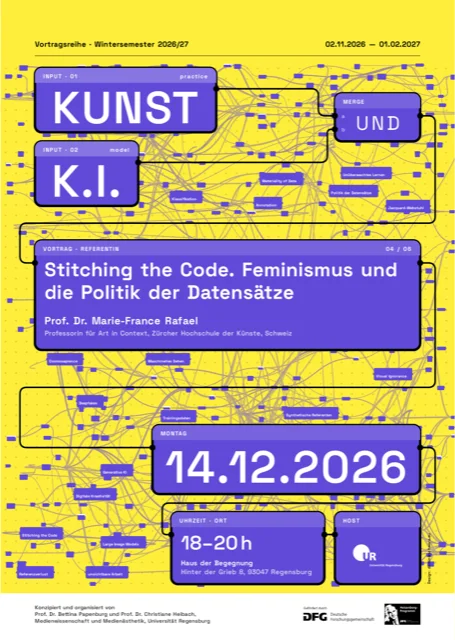
Marie-France Rafael (Zurich University of the Arts)
Stitching the Code. Feminism and the Politics of Datasets
18 January 2027
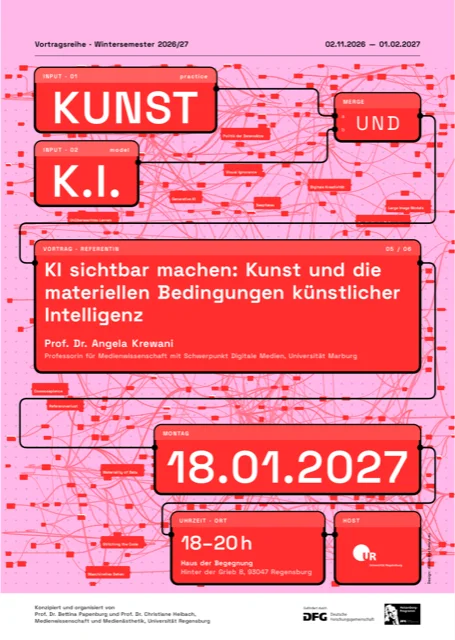
Angela Krewani (Philipps University of Marburg)
Making AI visible: Art and the material conditions of artificial intelligence
1 February 2027
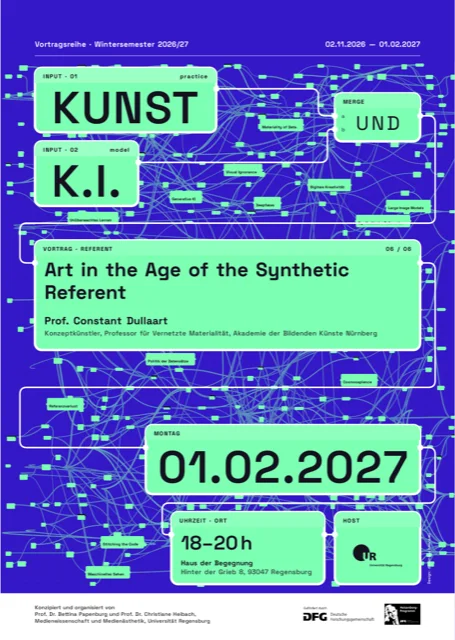
Constant Dullaart (Nuremberg Academy of Fine Arts)
Art in the Age of Synthetic – Speaker
Programme