


Prizes and foundations

Find out more about the equality prize awarded by the University of Regensburg and some external competitions and prizes.

Gender Equality Award

Gender Equality Award 2026

Invitation to tender

Apply now until 1 July 2026 for the University of Regensburg's Equality Award!

In 2026, commitment can be recognised in two categories:
1. First prize: Outstanding collaborative or group projects in research, 
academic teaching and self-administration, knowledge transfer or student
engagement with a central focus on equality and with the aim of creating 
equal opportunities and/or gender equality. The prize money in category 1
is €4,000.
2. Prize for qualification theses: Outstanding dissertation or habilitation at the 
University of Regensburg with a thematic and titular focus on gender studies and/or 
women's studies, completed between 1 October 2024 and 30 September 2025 .
The prize money in category 2 is €1,000.

More detailed information can be found in the full call for entries for the 2026 Equality Award (opens in a new window). (This PDF is not accessible)(PDF document, 202 KB).


Gender Equality Award 2025

Diversity working group of the Centre for Language and Communication

In her key work "Vita activa: or On the Active Life", the German-American political scientist Hannah Arendt explains the fundamental importance of human plurality as "the basic condition of acting as well as of speaking" (1967/2007: 213). For Arendt, action (actio) is therefore not only the highest form of human activity (alongside labour and production), but also the one in which the fundamental importance of plurality and thus, of necessity, diversity in human coexistence is most effectively brought to bear. "Diversity is a fact, inclusion a choice" therefore means, on the one hand, that the fundamental diversity of people is what makes political action and freedom of choice possible in the first place. Nonetheless, this action towards freedom can only happen intentionally, together, on the same wavelength and on the basis of intersubjective responsibility, respect and empathy.
No type of action emphasises human uniqueness and individuality more than language and speech. Language is a means and reflection of thought and can therefore also serve to mediate between different world views and perspectives. The flexibility and versatility of an individual language can, as it were, stimulate socially sustainable rethinking and creative action. Language not only mediates: it IS human action. It can have an exclusive or inclusive effect through minimal morphological, syntactic or lexical interventions. It can marginalise people in society or integrate them into communities. Language is politics, not only as an object, but also as a medium that has the power to constantly redefine the "we" and "us" and thus strengthen our community.

The winners of this year's University of Regensburg Gender Equality Award show just how important and effective inclusive action is, particularly in the area of language and communication. This prize has been awarded annually for the past four years to projects that have excelled in research, academic teaching, knowledge transfer or student engagement with a central reference to equality and with the aim of creating equal opportunities and/or gender equality.

The Diversity Working Group of the Center for Language and Communication, headed by Dr Julia Reinel, has been systematically committed to planning and implementing diversity-sensitive teaching and learning conditions since 2023. With a group of 13 volunteer employees, she has developed a wealth of concepts and strategies to promote inclusive education and equal opportunities in a short space of time. This includes raising awareness among all employees through further training and information materials, such as a 60-page awareness-raising brochure on the topic of equal opportunities and diversity, which expresses the many intersectional facets of equality and equal rights and enriches them with concrete case studies, pedagogical advice and a glossary with differentiated explanations. If you are not yet sufficiently familiar with terms such as "first generation", "partial performance disorder", "intersexuality" or "universal design for learning", I can warmly recommend this brochure as a good read.

The achievements of the working group also include barrier-free course rooms, lectures at international conferences, regular training programmes and a detailed GRIPS course "Diversity at the ZSK - Handouts for members of the teaching staff". The working group organises action days and weeks, e.g. on the occasion of German Diversity Day. The exhibition "(In)Visible: A look at gender in languages worldwide", which the working group organised in the foyer of the University Library in this year's summer semester, is particularly worth mentioning at this point. In collaboration with the Diversity and Anti-Discrimination Officer, Dr Birgit Bockschweiger, an exhibition concept was developed that deals with controversial and often only superficially understood topics such as the gender-sensitive use of language in German, the generic masculine and gendering in sign language and various individual languages from Turkish to Japanese. One highlight of the project was a keynote speech by constitutional judge Prof. Dr Ulrike Lembke on the legal and ethical foundations of gendering, to which the speaker gave clear and constitutionally sound advice.

With the prize money of 5,000 euros, the working group would like to further expand its training and awareness-raising programme, particularly in the area of transfer work in contact with students. I am looking forward to following this process and wish all those involved continued success and enjoyment. On behalf of the equal opportunities officer at the University of Regensburg, I would like to thank and congratulate you by name:

  • Dr Julia Reinel
  • Nadine Dechant
  • Alexandra Franke-Nanic
  • Florian Greiner
  • Christine Kramel
  • Dr Caroline Märzweiler
  • Markus Meilinger
  • Christina Ringlstetter
  • Julia Ruhstorfer
  • Dr Thomas Stahl
  • Timur Taşcan
  • Dr Michaela Trenner-Haberkorn
  • Françoise Vergès

Source reference:
Arendt, Hannah (1967/2007) Vita activa or On the Active Life. Munich: Piper.

(Text: Prof. Dr Astrid Ensslin, representatives of the University of Regensburg for the equality of women in science and art)
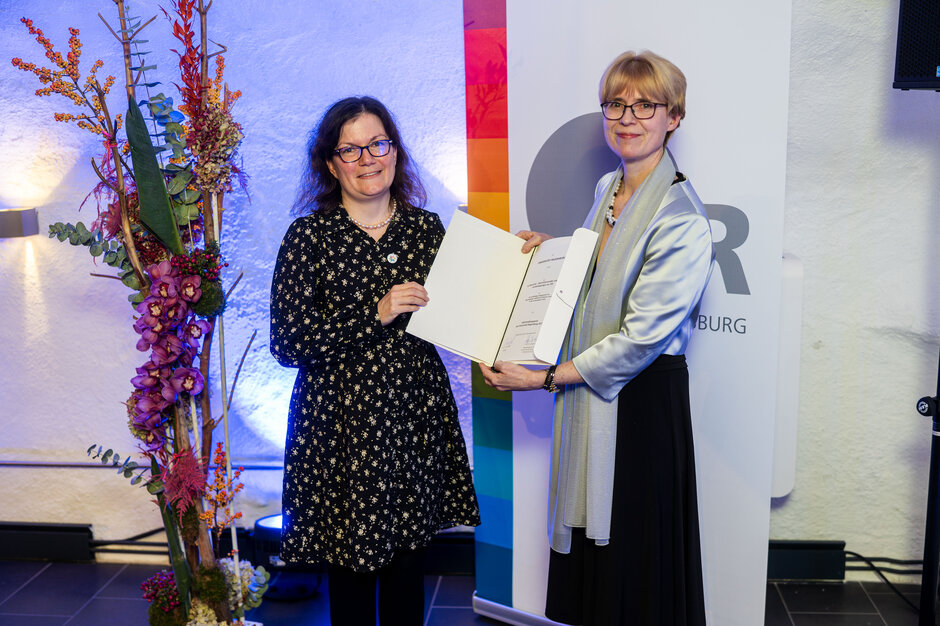
Photo: UR / Julia Dragan

Gender Equality Award 2024

The University Equal Opportunities Officer for Women in Science and Art, Prof Dr Astrid Ensslin, with the winners of the AG Medical Students for Choice Regensburg (Photo: Julia Dragan/UR).

Equality between women and men is one of the guiding principles of the University of Regensburg. In order to publicise achievements and progress in research and teaching in connection with the goal of actually implementing equal opportunities for women and men and gender equality, the University of Regensburg has been awarding a gender equality prize since 2004. The prize is endowed with € 5,000.00. The award ceremony took place on 6 November 2024 in the evening as part of a festive award ceremony (external link, opens in a new window).

This year, the prize was awarded to the AG Medical Students for Choice Regensburg for their commitment to the introduction of the constrained elective "Sexual Self-Determination and Reproductive Justice" in the medicine degree programme.

In her laudatory speech, Prof. Dr Astrid Ensslin, the University's representatives for equal opportunities for women in science and art, emphasised that the jury's decision was not easy this year either due to the outstanding and diverse applications and continued:

"Sascha Kneip, editor of the journal Aus Politik und Zeitgeschichte published by the Federal Agency for Civic Education, describes the democratic significance of reproductive self-determination in the special issue Reproductive Rights from 19 October 2024 as follows: "How extensive - or restrictive - reproductive rights are designed tells us a lot about the value of equality in a society and the quality of its coexistence." Or, to put it in the words of Professor Ulrike Lembke, a judge at the Constitutional Court of the State of Berlin, who is also represented in this special issue: "Anyone who cannot decide about their own body, their own family formation, their own future, will hardly be allowed or able to have a say as a responsible person on issues relating to the community ... Reproductive human rights are therefore a genuinely democratic concept." However, in order to be able to decide and act in a responsible, informed and reflective manner, basic education is required, and the jury of the University of Regensburg's Equality Award sees this postulate as a central foundation for the well-being of our future generations.

The winner (or winners) of the Gender Equality Award are a group of highly committed students who have made it their goal to actively shape sexual self-determination and reproductive rights as a transdisciplinary teaching and learning objective at the University of Regensburg. With the constrained elective of the same name, which is intended for medicine students, the Medical Students for Choice working group, under the auspices of the Chair of Pediatric and Juvenile Psychiatry and Psychotherapy, has created an interdisciplinary teaching programme that goes far beyond the controversial topic of abortion and abortion law. With courses on trauma sequelae after experiencing sexual violence, sexually transmitted diseases, genital mutilation of girls, participatory decision-making in the patient-doctor relationship and general counselling on the topic of sexuality, the constrained elective takes a holistic approach that addresses the complexity and preconditions of reproductive rights. It reflects the psychological, social, cultural and physiological complexities of its subject matter and thus reflects current and historical national and international debates against the backdrop of women's and inclusivity movements.

The jury found the courage and initiative of students such as Tabea Klaes, Hanna Hengst, Lea Steinecker and Hannah Franke to be just as important in facing up to the controversies of our time and tackling one of the greatest desiderata of medical care of our time with pedagogical pragmatism.
In this spirit, and on behalf of the equal opportunities officer at the University of Regensburg, I would like to congratulate the Medical Students for Choice working group on this success and wish all those involved every success in the further realisation of their teaching project."

To the tender text (external link, opens in a new window)(pdf file, 352 KB)

Gender Equality Award 2023

Award for the STEM project Girls Go Science - "Doing science yourself"

This year's award goes to the Girls Go Science (external link, opens in a new window) project, conceived, initiated and carried out by Dr Stephan Giglberger, Faculty of Physics. In this project, schoolgirls take part in several workshops, for example in the TMDC project, a project on transition metal di-chalcogenide investigations, in which they examine atomically thin semiconductors and realise that and how their layers can be made visible. The pupils learn how to make microscopes using 3D printers, which can be repeated at schools so that they can become multipliers. The jury was particularly impressed by the fact that the project is closely linked to current research at our university, concerns the STEM field, i.e. the field of mathematics, computer scientists, science and technology, and sees the schoolgirls as well as the Master's students and doctoral candidates who act as lecturers in the Girls Go Science programme as the scientists of tomorrow. The initiative can thus contribute to reducing structural discrimination and the resulting abuse of power. In terms of the university's gender equality perspective, it thus aims to bring about concrete improvements in the scientific community of the future.

With this award, the jury also recognises the Faculty of Physics' commitment to gender equality, including the people who have set the tone at the Faculty and for it in recent years, and the work of the equal opportunities officer for women in science and art at this faculty.

The jury of equal opportunities officers for women in science and art from all subject groups at this university acknowledges Dr Stephan Giglberger's outstanding contribution to equal opportunities with this project, while at the same time promoting links to the outside world, in addition to cooperation with schools through cooperation with the STEM labs. The jury would like to expressly thank him. The prize money will be used to continue and further develop the project in line with the call for entries.

Nadine Mundigl, a doctoral student working with Prof Dr Dominique Bougeard on a thesis on quantum effects in semiconductor nanostructures, receives her certificate on behalf of the doctoral students who are actively involved in the research in question. She took part in the STEM programme for young women in 2014, which was a decisive factor in her choice of study and her choice of the University of Regensburg. Hanifah Mumtaz, currently working on a thesis in mathematics with Prof. Dr Helmut Abeld on Sharp Interface Limits of Navierstokes/Allen Cahn systems , a former participant in the 2018 STEM programme and most recently a member of the teaching staff in the TMDC project, received an award certificate as a representative of the Master's students in the Girls Go Science project. The project would not have been so successful without Sandra Hannweg, a microsystems engineer and electronics technician for industrial engineering at the STEM labs, who is also actively involved in the Girls Go Science project. We welcome the fact that the city and the university are joining hands with her. Congratulations to them all from the University of Regensburg!

Gender Equality Award 2022

Main prize for Dr Heike Wolter

One of the greatest challenges facing society is recognising and appreciating the achievements of women in the same way as men. In 2022, the main prize will be awarded to a multi-stage initiative by Dr Heike Wolter, Academic Councillor, culminating in the children's book series "Strong Women", which is dedicated to this goal. It was created in conjunction with her history didactic teaching on "gender sensitivity in history lessons" and on the history of women, gender and masculinity. The book series "Starke Frauen" is published by edition riedenburg and reaches various social classes and age groups, both within and outside the university. One of its strengths is the diversity of the women selected for the biographical books - from Bertha Benz and Ruth Bader Ginsburg to Wangari Maathai and Angela Merkel. By combining teacher training, didactic programmes, including continuing education, and the use of the series in schools, the project starts early in order to convey a more gender-equitable view of history. Role models play a major role in this. It thus promotes gender sensitivity and equal opportunities in the long term. The project also has a sustainable character through its integration into the "Certificate in University Teaching" of the Centre for University and Academic Teaching with regard to contemporary knowledge and the skills of teachers.

Dr Wolter explains the concept of the books and the interaction between the genders:

"The research tasks and interactive book sections offered alongside the historically orientated main text are not intended to be aimed solely at girls and do not emphasise the gender aspect in a competitive way. Instead, in their consistent focus on self-realisation, they are intended to encourage everyone (even beyond binary gender constructions) to see themselves as a valuable and equal member of society."

Dr Wolter published a specialist article on the topic of "Strong women - learning with and from women's biographies" together with Julia Christof in Geschichte lernen 2022.

With this commitment, Dr Heike Wolter has rendered outstanding services to gender sensitisation and gender equality in academic teaching at the University of Regensburg and in knowledge transfer.

Dr Wolter works at the Chair of Modern History in the Department of Didactics of History at the Faculty of Philosophy, Art History, History, History, and Humanities at the University of Regensburg.


Antonia Reck

The Gender Equality Award 2022 in the category "Theses and Qualification Papers", endowed with €500, is awarded to Ms Antonia Reck for her outstanding cultural studies master's thesis entitled Zur Konstruktion weiblicher Geschlechterbilder und Rollenerwartungen in Kochbücher von und für jüdische Frauen zwischen 1901 und 1921. The thesis is an excellent example of a detailed analysis of the ways of thinking of a particular time and of social groups. The cultural studies investigation shows how expectations of women are not only explicitly but implicitly conveyed and passed on again and again, it addresses the current phenomenon of re-traditionalisation and, with this arc and the references to the present, makes historically well-founded and at the same time culturally plausible framed statements on the power of gender images believed to have been overcome in our time. Her work contributes to rethinking the norms that affect the balance of the sexes and encourages us to ask questions about the past and the present.

Antonia Reck is a graduate of the comparative european ethnology master's programme at the University of Regensburg and has worked on the food guide Jüdische Küche. History - People - Places. After completing her degree, she moved to a position at the Herzog August Library in Wolfernbüttel.

External prices

Regensburg Prize for Women in Science and Art

Laureate 2021:

Prof Dr Konstantina Papathanasiou, Faculty of Law, UR

Press release of the UR on the award ceremony on 27 October 2021 (external link, opens in a new window)

Laureate 2019:

PD Dr Friederike Kind-Kovács, Faculty of PKGG, UR

Press release of the UR on the award ceremony on 25 October 2019 (external link, opens in a new window)

Prize winner 2017:

PD Dr Sara Collins, Faculty of Physics, UR

Press release of the University of Regensburg on the award ceremony on 25 November 2017 (external link, opens in a new window)

Prize winner 2014:

PD Dr Sabine Amslinger, Faculty of Chemistry and Pharmacy, UR

PD Dr Babett Edelmann-Singer, Faculty of PKGG, UR

More: www.regensburg.de/rathaus/ehrenbuerger-und-medaillen/preis-fuer-frauen-in-wissenschaft-und-kunst (external link, opens in a new window)

Christiane Nüsslein Vollhard Foundation

To promote excellent female scientists in the fields of experimental natural sciences and basic medical research with children.

more: www.cnv-stiftung.de (external link, opens in a new window)

For Women in Science - UNESCO-L'Oréal support programme

For female scientists with children; there is a German and an international programme.

more: www.fwis-programm.de (external link, opens in a new window)

Helene Lange Prize

For young female scientists in the STEM disciplines.

more: www.helene-lange-preis.de (external link, opens in a new window)

Women's STEM Award

For the final theses of female students in STEM subjects.

more: www.frauen-mint-award.de (external link, opens in a new window)

EU Prize for Women Innovators

The European Union honours women who have (co-)founded their own company and carried out an EU-funded research or innovation project. A total of three innovative female entrepreneurs are honoured with prize money.

European Prize for Women Innovators (external link, opens in a new window)

ARD/ZDF Award for Women + Media Technology

For theses with a technical reference to television, radio or online media

more: www.ard-zdf-foerderpreis.de (external link, opens in a new window)

Runnenbaum Foundation | Academic and social support for single parents

Ingrid zu Solms Prize for Natural Sciences, Life Sciences and Engineering

Awarded by the Ingrid zu Solms Foundation, Frankfurt am Main, for an outstanding doctorate with a future-oriented research focus in the field of physics, biology, chemistry, mathematics, computer scientists or engineering, also with an interdisciplinary orientation.

Endowment: 5,000 euros
Application deadlines: by 15 May of each odd-numbered year

Women up to the age of 40 who have completed a doctorate at a university in a German-speaking country (Germany, Austria, Switzerland) are eligible to apply.

more: www.ingrid-zu-solms-stiftung.de/NLI.html (external link, opens in a new window)

The academics prize for young talent

Every year, the academics Young Talent Award (external link, opens in a new window) honours scientists in the early stages of their careers who have had a lasting positive impact on science and research through their outstanding commitment.

To top