


Funding programs, fellowships and scholarships
November 2026
- CfP: International Conference “Ukrainian Art History: Working Through Uncertainties” at INHA Paris, March 2027 | Deadline 8 November, 2026! (external link, opens in a new window)
- ETH Zurich: Innovate Cities and Infrastructure Programme – grants with an expanded thematic focus on Ukraine | Deadline: 15 November 2026! (external link, opens in a new window)
- KIU Guest Lectureship in Interdisciplinary Ukrainian Studies: scholars from all disciplines with topics related to "Institutional and Social Changes in Ukraine”| Deadline 15 November, 2026! (external link, opens in a new window)
- CfP: Humans, Animals, Nature: Everyday Life in (Post-)Conflict Societies in Eastern and Southeastern Europe and the Caucasus since 1989, Feburuary 2027 | Deadline 20 November, 2026! (external link, opens in a new window)
- IOS Regensburg: Early-Stage Postdoctoral Researcher (100 % FTE) at the Leibniz ScienceCampus. Limited 12 month contract starting 1.4.2027 | Deadline 30. November, 2026! (external link, opens in a new window)
Future events and conferences
October 2026
Ukraine Days in Brandenburg | 7–9 October | Wildau & Berlin
 © DUAG/TH Wildau
The Days of Ukraine 2026, the annual conference of the German-Ukrainian Academic Society (DUAG e.V.), will take place this year at the Technical University of Applied Sciences in Wildau (external link, opens in a new window).
Under the patronage of the Minister for Science, Research and Culture (external link, opens in a new window), Dr Manja Schüle, the event is being organised by Prof. Dr Marcus Frohme (external link, opens in a new window) and his team.
The Days of Ukraine will also mark the 10th anniversary of the DUAG.
Participation is free of charge and registration for the event is open until 31 August 2026.
Ukraine Days 2026 in Brandenburg – Registration (external link, opens in a new window)
Webinar: ‘Ukraine’s Archival Landscape’ | 9 October 2026
Webinar series – online via Zoom – free and open to all – every other Friday, 28 August – 20 November 2026
Webinar 4 · Central State Audiovisual and Electronic Archives
Speaker: Dr Tetiana Yemelianova | Moderator: Prof. Dr Susanne Strätling
This lecture focuses on the Central State Audiovisual and Electronic Archives — a key centre for preserving Ukraine’s audiovisual documentary heritage — and on the opportunities it offers for research infrastructure and cultural engagement. It will present the most representative ‘storylines’ within the collections of film, video, photographic and phonographic documents, with an emphasis on their potential as sources for the history of Ukraine and its cultural, academic and social life, its international relations, and more.
The lecture will be of interest to historians, archivists, cultural theorists, media scholars, teachers, students and all those who work with the documentary heritage of Central and Eastern Europe. It will contribute to making Ukrainian archival collections more accessible to the international academic community, and thereby to the integration of Ukraine’s audiovisual heritage into the wider academic and cultural world.
Register here for the webinar (external link, opens in a new window)
Webinar: ‘Ukraine’s Archival Landscape’ | 23 October 2026
Webinar series – online via Zoom – free and open to all – every other Friday, 28 August – 20 November 2026
Webinar 5 · Central State Historical Archives of Ukraine in Lviv
Speaker: Olesia Stefanyk | Moderator: Dr Clare Griffin
The Central State Historical Archives of Ukraine in Lviv (TsDIAL of Ukraine) was founded in 1784 as the Imperial-Royal Office for Ancient Galician Castle and Land Deeds and the Verification of Documents. Today, TsDIAL of Ukraine holds more than 1,120,000 files dating from the early twelfth to the twenty-first century, including 331 documents designated as unique. Despite martial law, the archives have continued to operate from the very first day of Russia’s full-scale war against Ukraine, fulfilling one of their core functions: safeguarding their documentary and irreplaceable historical heritage.
The lecture will be of interest to historians, genealogists, archivists, medievalists, students, and anyone researching the history of Ukraine and of Central and Eastern Europe.
Register here for the webinar (external link, opens in a new window)
November 2026
Webinar: ‘Ukraine’s Archival Landscape’ | 6 November 2026
Webinar series – online via Zoom – free and open to all – every other Friday, 28 August – 20 November 2026
Webinar 6 · Central State Archives of Public Organisations and Ukrainica
Speaker: Olha Bazhan | Moderator: Prof. Dr Sarah Phillips
This lecture offers a comprehensive analysis, grounded in history and source studies, of the informational potential of the holdings of the Central State Archives of Public Organisations and Ukrainica (TsDAHOU). It examines the archives’ principal documentary collections reflecting the socio-political history of Ukraine in the twentieth and twenty-first centuries — in particular the records of political parties, civic movements and associations at the national level, as well as the body of foreign Ukrainica: documents removed abroad at various times or created by the Ukrainian diaspora.
The lecture will be of interest to historians, archivists, political scientists, researchers specialising in twentieth-century repression, political parties and civic movements, and the Ukrainian diaspora, as well as students and anyone working with the documentary heritage of Central and Eastern Europe.
Register here for the webinar (external link, opens in a new window)
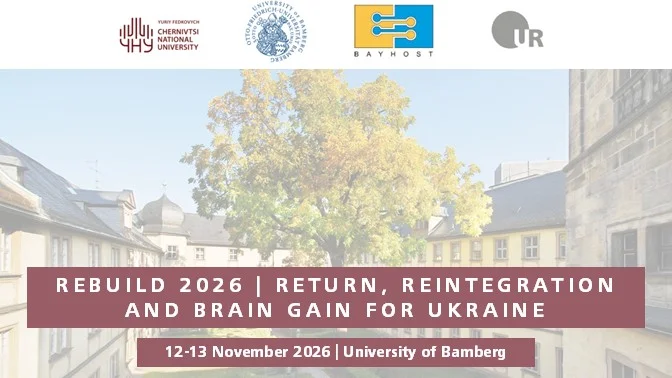
REBUILD 2026 | 12–13 November 2026
Multinational BAYHOST workshop on return and (re-)integration in Ukraine | 12–13 November 2026
Return, Reintegration and Brain Gain for Ukraine: Lessons from Central, Eastern and South-Eastern Europe
Multinational BAYHOST workshop in cooperation with the University of Bamberg and Yuriy Fedkovych Chernivtsi National University
On 12 and 13 November 2026, BAYHOST, the Otto Friedrich University of Bamberg and the Yuriy Fedkovych Chernivtsi National University will host the multinational workshop ‘REBUILD 2026 – Return, Reintegration and Brain Gain for Ukraine: Lessons from Central, Eastern and South-Eastern Europe’ in Bamberg.
Participation in the workshop
Participation is free of charge. The registration has been closed - we ask for your understanding!
REBUILD 2026 – Registration (external link, opens in a new window)
* The number of participants in the workshop is limited. Should the maximum capacity be reached before the date stated here, registration may close earlier.
Event programme
Further information on the schedule and content of the BAYHOST REBUILD 2026 workshop can be found in the program as well as on the event page
Program Draft, 22.10.2026 (PDF) (opens in a new window). (This PDF is not accessible) Further information (event page)
Webinar: “Ukraine’s Archival Landscape” | 20 November 2026
Webinar series – online via Zoom – free and open to all – every other Friday, 28 August – 20 November 2026
Webinar 7 · Central State Archives – Museum of Literature and Art of Ukraine
Speaker: Olena Chyzhova | Moderator: Jeannette Brabenetz
Founded in 1966, the Central State Archives Museum of Literature and Art of Ukraine (TsDAMLM of Ukraine) is a leading archival and museum institution. It preserves the personal fonds of prominent figures in Ukrainian literature, fine art, music and theatre; the documentary heritage of cultural institutions of national significance; museum objects that belonged to writers and artists; and printed editions. Its 1,450 fonds currently comprise 325,625 items, 13,406 museum objects, and some 203,000 printed editions.
The lecture will be of interest to literary scholars, art and theatre historians, archivists, curators, students, and anyone interested in Ukrainian culture and its documentary heritage.
Register here for the webinar (external link, opens in a new window)
Archive
Memory Matters: Non-Human Agents in Memory Studies | 05.-06.02.2026
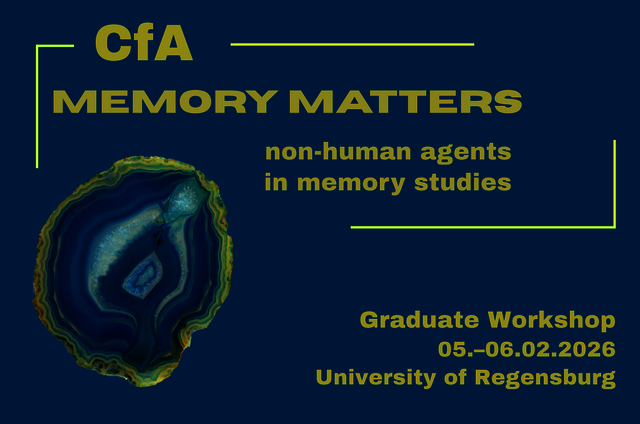
7th Annual Graduate Workshop of the GS OSES at the University Regensburg in cooperation with the Leibniz ScienceCampus Europe and America in the Modern World.
From witnessing stones and talking rivers to breathing ruins: The 2026 Graduate Workshop Memory Matters: Non-Human Agents in Memory Studies seeks to highlight how materials, objects, geological strata, and the environment function both as archives of (collective) memory and as agents that foster memory practices outside, beyond, and at times against well-established institutions and dominant narratives. The workshop will be held from 05-06 February 2026 at the University of Regensburg and invites applications that explore entanglements between material culture and memory studies.
We welcome research addressing the themes of the workshop in any context from around the world. Contributions featuring East and Southeast Europe, or the Americas, as well as comparative studies, are particularly welcome given the focus of the expertise in Regensburg. The workshop will be held in English.
Notice: Applications are closed!
In case of questions please contact gsoses.conference@ur.de. (external link, opens in a new window)
Days of Ukraine in Bayreuth, Bavaria 2025 | 1-2 October 2025
The Days of Ukraine is an annual event organized by the German-Ukrainian Academic Society (DUAG) in a different federal state of Germany since 2016. Taking place at the University of Bayreuth on 1-2 of October 2025, this year's Days of Ukraine in Bavaria / Tage der Ukraine in Bavaria is organised together with the Chair for Metals and Alloys of the University of Bayreuth and focuses on Bavarian-Ukrainian projects.
This year's event is organised under the motto "Bridging Ideas, Building Knowledge - Shaping Excellence and Partnership / Ideen entwickeln, Wissen aufbauen - Exzellenz und Partnerschaft stärken". The programme brings together representatives from universities, research institutions, funding bodies, and governmental organisations to engage in dialogue, exchange experiences, and explore new formats of collaboration.
The registration for this event is open until 31.08.2025!
For more information, please visit The UKRAINE Network here (external link, opens in a new window)!
Organisations in Times of War: Ukraine, Eastern Europe and Beyond

October 8-10, 2025 at University of Regensburg | Denkraum Ukraine
Scholars and practitioners are invited to contribute their research and perspectives on how war affects organisations and institutions in the fields of economics, politics, law, history, culture, and beyond.
The conference is organized by the Center for Interdisciplinary Ukrainian Studies Think Space Ukraine, established in 2024 at the University of Regensburg and financed by the DAAD (German Academic Exchange Service) through funds from the German Federal Foreign Office (AA). The Center pursues a discursive, relational, and action-oriented approach to Ukraine-related research in culture, economics, politics, and law within (trans)regional and global contexts. The Annual Conference is one of the Center's key events, aiming to further develop established contacts in research, exchange, and knowledge transfer into an internationally visible scientific hub.
Applications for the conference are closed. (external link, opens in a new window)
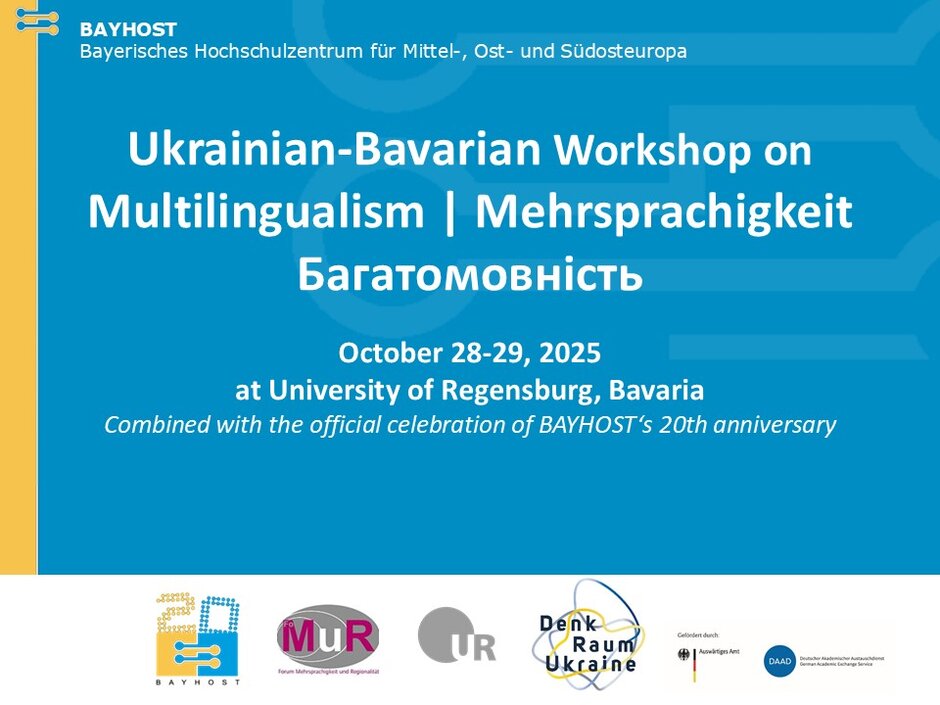
Bavarian-Ukrainian Workshop on Multilingualism | 28-29 October 2025
 © Koordinationsstelle Ukraine, BAYHOST (2025)
BAYHOST-Workshop @University of Regensburg
The Bavarian University Centre for Central, Eastern and Southeastern Europe (BAYHOST), the Centre for Interdisciplinary Ukrainian Studies "Denkraum Ukraine (external link, opens in a new window)" and the Forum Multilingualism and Regionality"FoMuR" (external link, opens in a new window) at the University of Regensburg are organising a workshop on cooperation with Ukraine in the research and teaching field of "multilingualism" from 28-29 October 2025 in Regensburg.
This year's event will follow on from the previous conference in 2024, but this time will be dedicated exclusively to the topic of "multilingualism", with a focus on language didactics and trauma processing. Here, too, the aim of the workshop is to establish and deepen cooperation with Ukraine.
The workshop is aimed at interested teachers and researchers in Bavaria, Ukraine and other countries.
Registration for the workshop is closed - thank you very much for the great interest!
You can find the preliminary program (opens in a new window). (This PDF is not accessible) here.