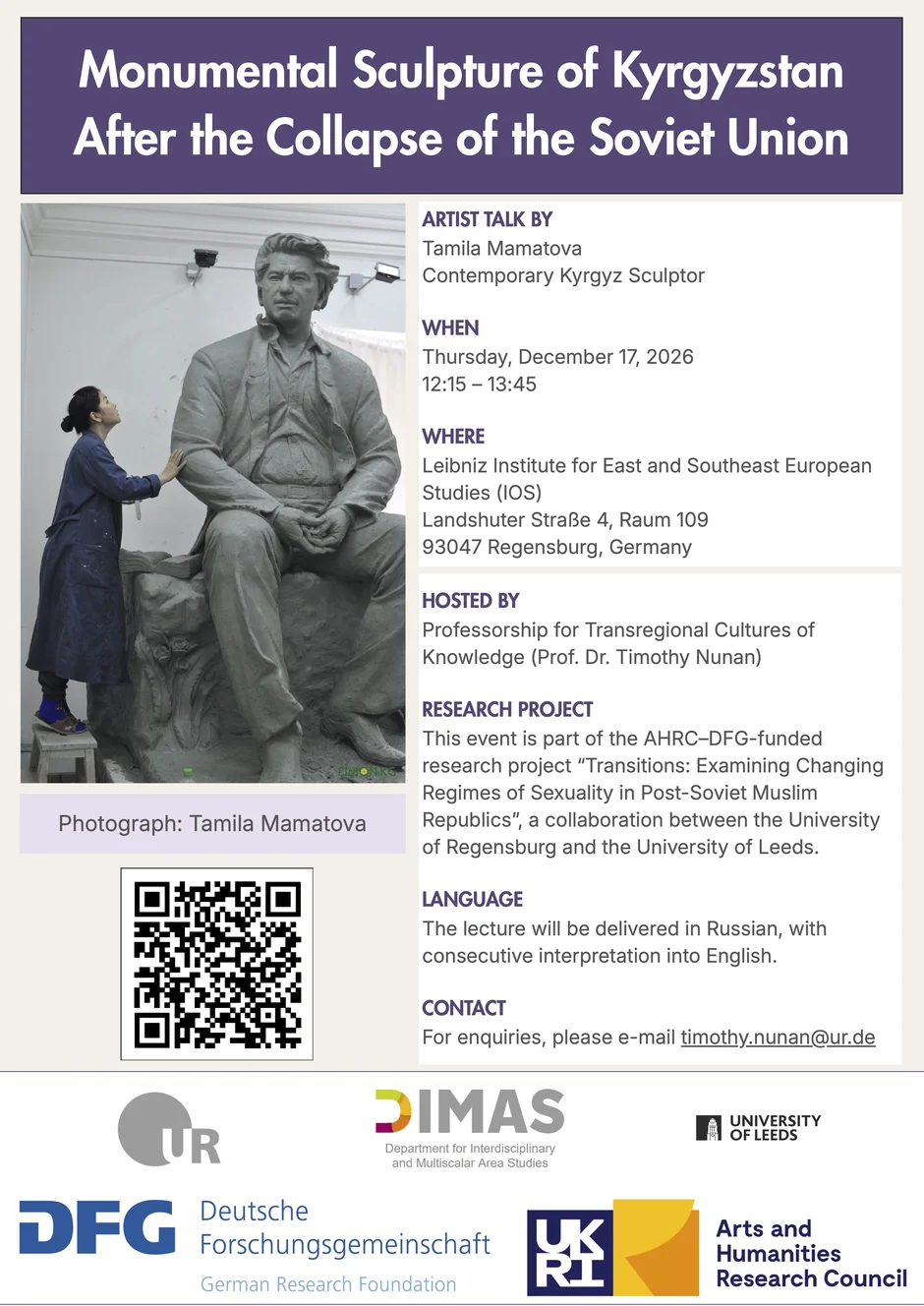
During its nearly seven decades of existence, the Soviet Union promoted monumental sculpture across a vast geographical space. Perhaps most famously, state authorities erected statues of Vladimir Lenin and Joseph Stalin throughout the USSR itself, as well as across Central and Eastern Europe after World War II. Some of these monuments, like those of Stalin in Budapest or Prague, were torn down during moments of revolution or de-Stalinization; others, like the massive bust of Karl Marx in Chemnitz (formerly Karl-Marx-Stadt), remain key parts of the urban landscape. Since the mid-2010s, meanwhile, countries like Ukraine have passed laws mandating the removal of such monuments. Yet the history of monumental sculpture is more complicated than the simple reversal of a Communist legacy. How do states, publics, and artists negotiate the commemoration of historical figures in urban spaces that remain deeply shaped by Soviet architecture? How can monumental sculpture memorialize prominent figures while also promoting a critical perspective on the past? And how are these delicate issues addressed in contexts like Kyrgyzstan—a former Soviet republic in Central Asia where the Soviet and Russian legacy is frequently viewed through a colonial lens? To explore these questions, Kyrgyz sculptor Tamila Mamatova will deliver a lecture about her work in monumental sculpture and the broader challenges facing the art form in Kyrgyzstan since the early 1990s. Mamatova is best known as the sculptor of "Manas the Magnanimous" (2025), a major monument to the hero of the Kyrgyz national epic installed in central Bishkek on the former site of a Lenin statue. Her body of work also includes numerous busts and memorials to prominent historical figures, including installations at the Kyrgyz Embassy in Berlin and the Chamber of Industry and Commerce in Erfurt. Her sculptures have been featured in exhibitions and symposia across Russia, Hungary, Italy, Turkey, and Kazakhstan. Ms. Mamatova, currently visiting Regensburg as a fellow within the AHRC-DFG project “Transitions: Examining Changing Regimes of Sexuality in Post-Soviet Muslim Republics,” will discuss her work and the broader métier of monumental sculpture.
The lecture will be moderated by Professor Timothy Nunan (Transregional Cultures of Knowledge, DIMAS). The presentation will be delivered in Russian, with consecutive interpretation into English. For questions, please contact either Timothy Nunan (timothy.nunan@ur.de) or “Transitions” Project Manager Jack Broughton (transitions@ur.de).