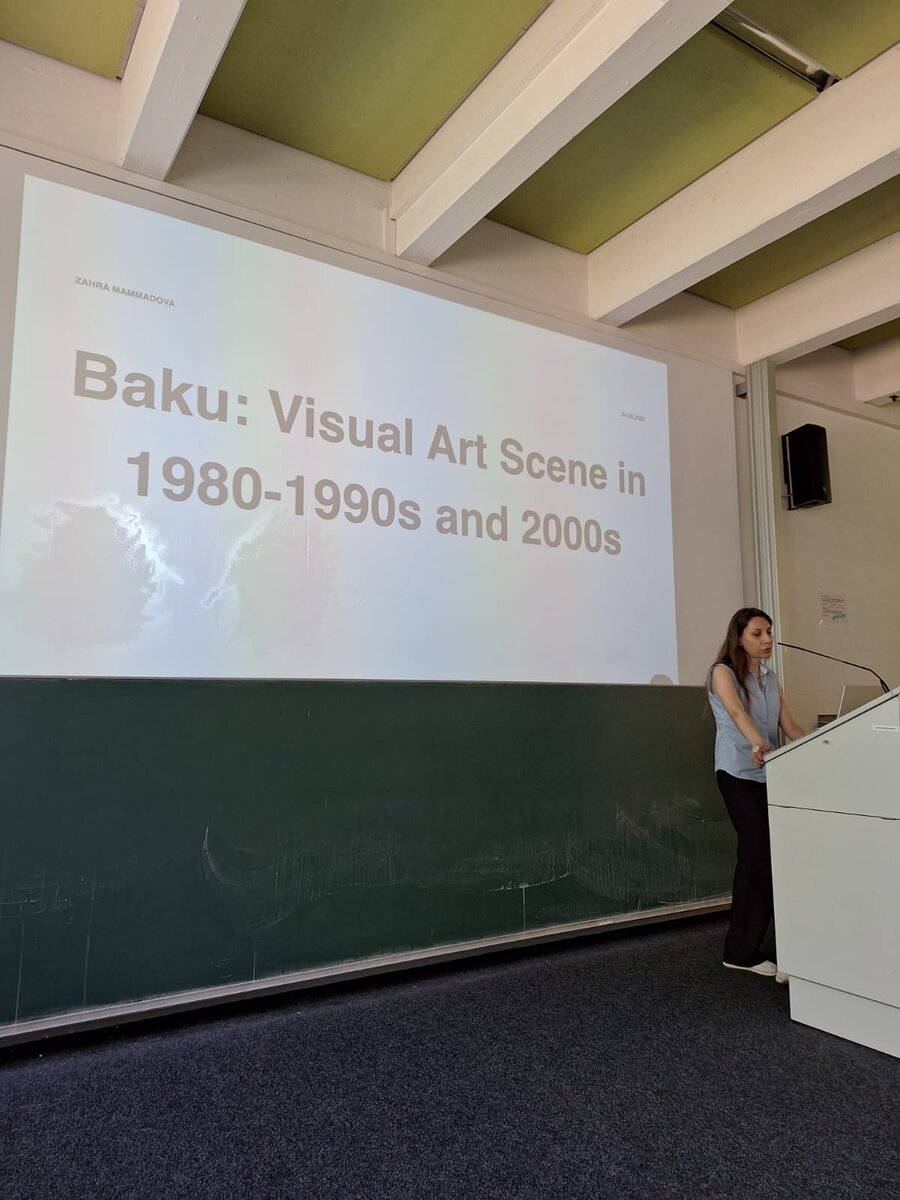
Drawing on her research into visual materials, the journals of art collectives, and interviews with prominent artists, Mammadova explored how Azerbaijani artists turned from the proscribed Soviet-era framework of socialist realism toward engagement with religious transitions, ecology, and gender. In her talk, she explained how traditional art in Azerbaijan had historically focused on geometric figures and folkloric themes. As the country rapidly modernized following the discovery of oil in Baku in the late nineteenth century, and in particular following Azerbaijan’s violent incorporation into the Soviet Union in 1920, the country’s artistic traditions were brought in line with Soviet artistic norms, drawing on Russian painting and socialist realism.
However, explained Mammadova, as Soviet leader Mikhail Gorbachev gradually loosened norms surrounding artistic expression in the mid-1980s, Azerbaijani artists like Javad Mirjavadov (1923-1992), Korkmaz Efendiyev (1939-1993) began to engage with alternative traditions. As Mammadova demonstrated with examples of both artists’ works, Mirjavadov produced carnivalesque paintings featuring demonic figures—divs or jinns— reflecting Azerbaijan’s Islamic and pre-Islamic traditions. In contrast, Efendiyev scavenged through waste sites in Baku to produce art installations made from industrial scrap. At the same time, explained Mammadova, Efendiyev’s works also referenced a Sufi Islamic cosmology. Thus, already before the Soviet collapse were artists like Mirjavadov and Efendiyev forging new traditions that would inspire new generations of artists.
Mammadova’s talk then turned to the 1990s, a period of political transformation and war in Azerbaijan. Amid the conflict over Nagorno-Karabakh, Gorbachev dispatched troops into Baku in January 1990 to suppress anti-Soviet protests, leading to the deaths of hundreds. Amid this crisis, a group of Azerbaijani artists founded the Təsdig Art Group, a collective inspired both by Sufi practices as well as surrealism and psychology. (The word “Təsdig” derives from the Arabic term تصديق, meaning ‘belief’ or ‘trusting’ and referring to inner conviction and belief in the heart.) Təsdig Art Group was short-lived, existing only from 1990–1992, but it reflected a larger turn toward spirituality in the arts as Azerbaijan gained independence in 1991. Moreover, as foundational figures like Mirjavadov and Efendiyev both passed away in the immediate years thereafter, it was left to younger artists to chart a course forward.
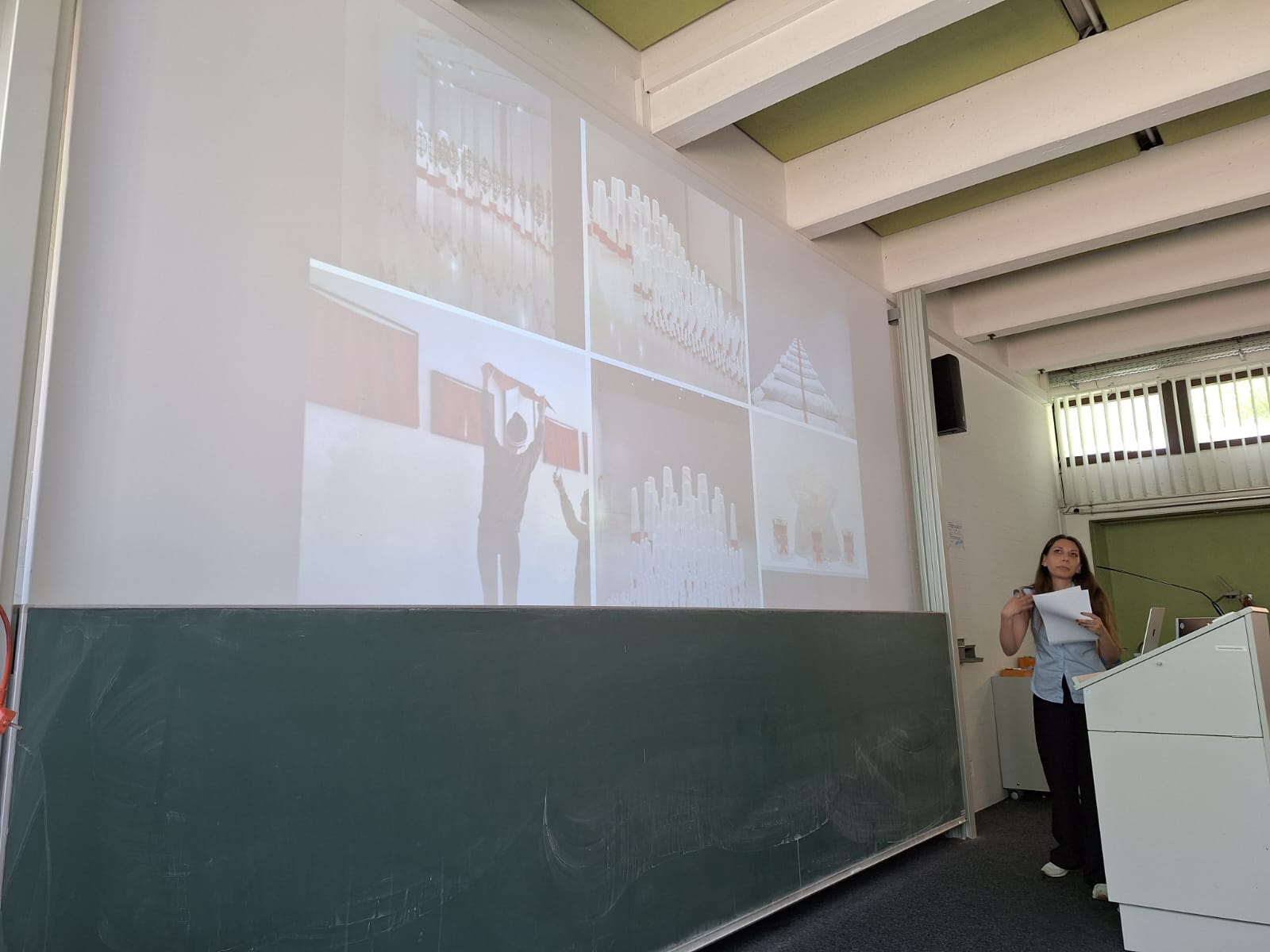
Mammadova then turned to the emergence of the environment as a theme in Azerbaijani art. Baku was a major hub for oil extraction and petroleum engineering during the Soviet Union, but these industries had a deleterious impact on the flora and fauna of the region, as well as the Caspian Sea. Moreover, the collapse of the Soviet-era planned economy led to widespread deindustrialization. In this context, new art groups and experimental research-based initiatives like Labyrinth pursued land art projects that thematized these issues and the industrial legacies of the Soviet Regime. Among these two projects stand out. In of their land art action and performances, titled “The Island” (2003) members of the collective took over Nargin Island, a small island near Baku that had once housed political prisoners. There, the group and invited artists from Georgia, Lithuania, Latvia and France spent ten days responding to the post-industrial landscape, experimenting with a variety of artistic media, such as site-specific installations, performances, and interventions. In another notable project, “Paradise Lost” (1999) the group worked with a 15th-century bathhouse on the verge of destruction on the Absheron Peninsula along the Caspian coast. By using a large piece of whitefabric, the artists viewing public audience created a site-specific installation. They wrapped the building in the fabric and then released it into the sea. This symbolic gesture alluded to the healing of the building, the hope for its renewal and cleansing from the “pain” of destruction and neglect. With embracing land art techniques and participatory art, the artists adressed the enduring colonial legacy of the Soviet era through the lens of the local cultural heritage. In this action the group called attention to and explored the questions of national identity and memory.
Parallel to this, other art collectives like Arts Etc. registered themselves as cultural NGOs and produced works relating to both the environment and Sufi cosmologies. As Mammadova explained, some of the most prominent Azerbaijani artists working today, such as Sabina Shikhlinskaya (1962-) and Chingiz Babayev (1964-), founded these groups. The 1990s also saw greater involvement by Western NGOs into the Azerbaijan arts scene. For instance, the Open Society Foundations provided grants and fellowships to Azerbaijani artists through its Open Society Assistance Foundation. Nonetheless, throughout this period, the Azerbaijani art scene largely self-organizing—and primarily led by women.
Yet by the 2000s, Mammadova explained, these basic conditions of art production were changing. 2007 marked Azerbaijan’s inaugural pavilion at the Venice Biennale, group exhibition “Omnia mea” curated by Shikhlinskaya and Leyla Akhundzadeh (1953–2010). The pavilion, together with major exhibitions like “USSR-Remix” (exhibited in Dresden in 2008) and ‘Art Is Not Only Ugly’ (exhibited in Berlin in 2009) contributed to a greater visibility of Azerbaijani art in Europe. Azerbaijan also undertook ambitious investments into art galleries and art museums during this period. Among these was the YARAT Contemporary Art Space, founded in Baku in 2011. (Mammadova worked as a curator at YARAT from 2021-2025.) The following year likewise saw the opening of the Heydar Aliev Center, a major complex designed by architect Zaha Hadid that has hosted international art exhibitions.
Parallel to a greater visibility of Azerbaijani art on the European stage, Azerbaijani artists have thematized questions of gender and sexuality, marking a shift from the predominant focus on spirituality and ecology. Yet, these interventions into these themes has often provoked controversy. In her lecture, Mammadova took on several cases of Azerbaijani artists, such as Babi Badalov (1959-), Aidan Salakhova (1964-), and Sitara Ibrahimbayli (1984-). As Mammadova showed, Badalov’s’ work has been marked by a fascination with ambiguity in language and gender, as well as the creative potential in challenging the gendered nature of certain art materials (for instance, textiles or fabrics as ‘female’ art media). Works by Salakhova and Ibrahimbayli have thematized female intimate areas in their work, touching on controversial themes such as virginity, marriage, and female honor. As Mammadova argued, these works have often reflected on what artists perceive as the oppressive force of tradition and religion. They have, however, also led to demands to cover works or have exhibitions shut down entirely.
As Mammadova concluded, the trajectory of art in Azerbaijan since the 1980s reflects several trends common to the post-socialist world. Azerbaijan, she argued, offers a rich example of how post-socialism created dislocations of time and place. During the Soviet Union, Azerbaijan had long served the role of a ‘domestic East’ and a model of Soviet modernity to the Islamic world. Following the dissolution of the Soviet Union, it no longer embodied a potential future for such regions, but the promised transition to capitalist modernity and liberal democracy proved slow in coming. Azerbaijan was, reflected Mammadova, caught between the ‘no longer’ of Soviet socialism and the ‘not yet’ of transition. At the same time, as European art circuits ‘discovered’ Azerbaijan, it was difficult for Azerbaijani artists not to be perceived primarily through a gaze that exoticized them as a ‘new East.’ Within Azerbaijan, meanwhile, artists reflected on aspects of the Soviet past—for instance, Nargin Island—but most of their work focused on the oppressive force of national tradition.
Following the talk, Mammadova engaged in a question and answers with Professor Nunan, students, and colleagues from the University of Regensburg. Questions touched on the trajectory of Soviet-era art institutions (art academies and museums) after 1991; the role of foreign Embassies and NGOs in promoting certain art currents in Azerbaijan; and the impact of the 2012 Eurovision Song Contest on creative and performing arts in Azerbaijan. The lecture and subsequent conversations between Mammadova and the Regensburg “Transitions” team provided inspiration for their ongoing research. Mammadova is expected to return to Regensburg for future visits as a visiting scholar in late 2026 and 2027.
Mammadova’s talk was part of her stay in Regensburg as a visiting scholar within the research project “Transitions: Examining Changing Regimes of Sexuality in Post-Soviet Muslim Republics.” The project, a binational research collaboration between the University of Regensburg and the University of Leeds, is generously supported by the Deutsche Forschungsgemeinschaft (DFG) and the Arts and Humanities Research Council (AHRC).