

We are pleased to announce a new publication by Maximilian Pichler and Yannek Käber, “Inferring processes within dynamic forest models using hybrid modelling”, published in Methods in Ecology and Evolution (MEE, open access, 16 June 2026).
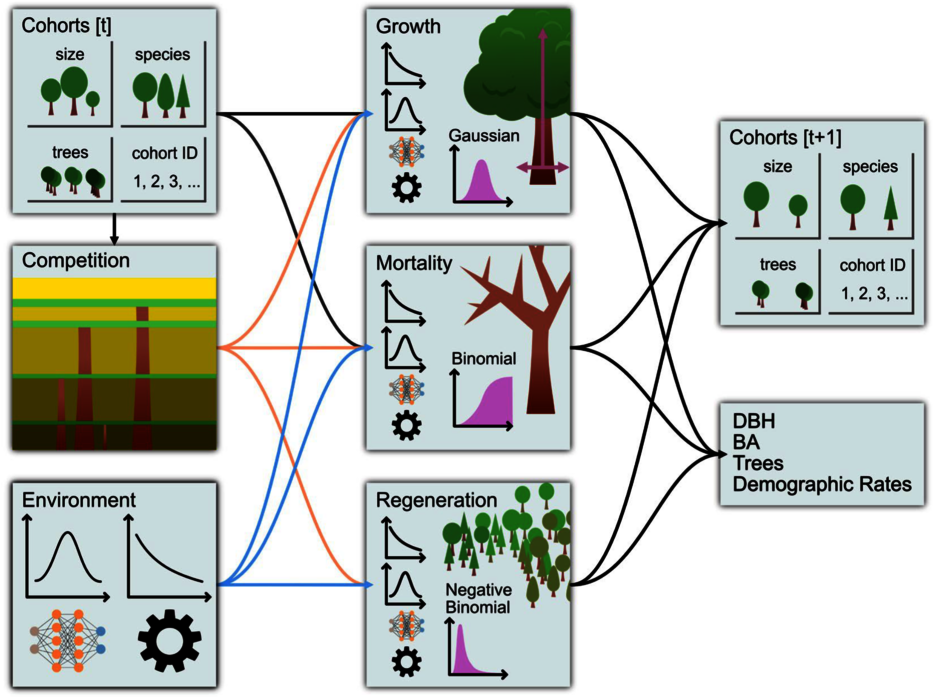
The paper introduces Forest Informed Neural Networks (FINN), a hybrid approach that embeds deep neural networks within a forest gap model. Instead of relying on fixed mechanistic formulations, FINN lets the neural networks learn effective process forms while aligning them with the other components of the dynamic vegetation model, all calibrated jointly. It is implemented in torch for R, making it fully differentiable and enabling efficient end-to-end optimisation.
Using simulated data and a case study of the 50-hectare Barro Colorado Island plot, the authors show that the approach reliably recovers process parameters and known functional forms, and that the hybrid model produces ecologically plausible long-term succession trajectories. The work demonstrates how hybrid modelling can improve the internal consistency of forest models and support more reliable forecasts of ecosystem trajectories under environmental change.
There is also a very nice MEE Blog post about the story behind the paper and a plain language summary: https://methodsblog.com/2026/07/07/hybrid-forest-models-integrating-mechanistic-knowledge-and-data/ (externer Link, öffnet neues Fenster)
Read the full article: doi.org/10.1111/2041-210x.70347
Kontakt aufnehmen
Dr. Maximilian Pichler
Ecological Machine Learning Group
Homepage see here