

Solidarity with Ukraine

BAYHOST declares its solidarity with its cooperation partners in science and higher education, grantees and alumni from Ukraine and condemns the Russian attack on Ukraine.
The Russian attack on Ukraine harms the successful and friendly cooperation with partner institutions in both Ukraine and Russia that has grown over many years.
Our thoughts are with the Ukrainian researchers, students and alumni and their families.
In future, BAYHOST would like to do more to promote student exchange and academic cooperation with Ukraine within the scope of its possibilities.
Country studies
BAYHOST Competence Atlas
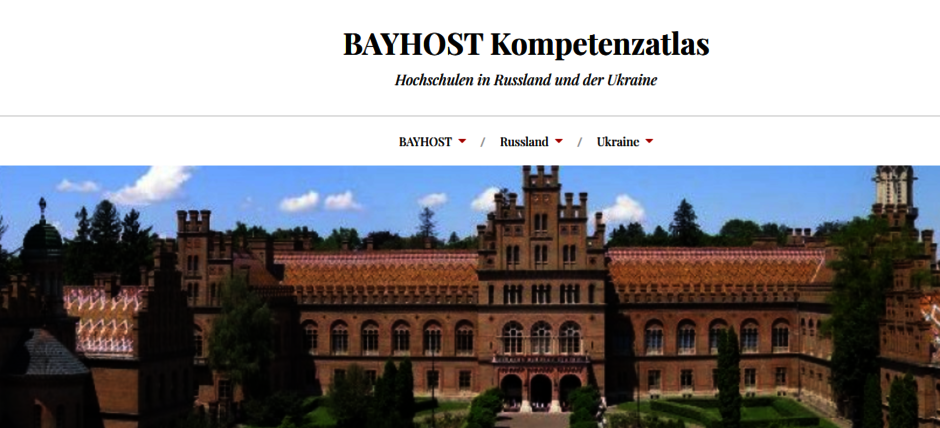
on universities in Ukraine
The BAYHOST Competence Atlas "Universities in Ukraine" provides quick and comprehensive information on the most important Ukrainian universities in short profiles. BAYHOST also provides regular news updates from the higher education and research landscape in the country, which can also be subscribed to in order to stay up to date.
to the Ukraine Competence Atlas (external link, opens in a new window)(in German language only)
Vocational education and training in Ukraine:
A system in transition
In Ukraine, vocational education and training has been in a state of flux for several years - dual elements have also been integrated into training.
GOVET guest article by Snizhana Leu-Severynenko, PhD (Independent Education Expert, Kyiv). to the article (external link, opens in a new window)
Higher education during the war
From Revolution to Resilience: The Transformation of the Ukrainian Higher Education Sector in Times of Crisis and War.
Country Analyses Ukraine. Issue 318 (external link, opens in a new window) (in German language only)
Digital transformation ahead of schedule
How Ukrainian Universities Survive and Transform in Times of War.
An interview with Kateryna Suprun, Ministry of Education and Science of Ukraine, conducted on 25.10.2022 by Christoph König, Program Manager at the Stifterverband für die Deutsche Wissenschaft, and Nataliia Sokolovska, researcher and project manager in the "Knowledge and Society" program at the Alexander von Humboldt Institute for Internet and Society. University Forum on Digitalisation.
The higher education system in Ukraine
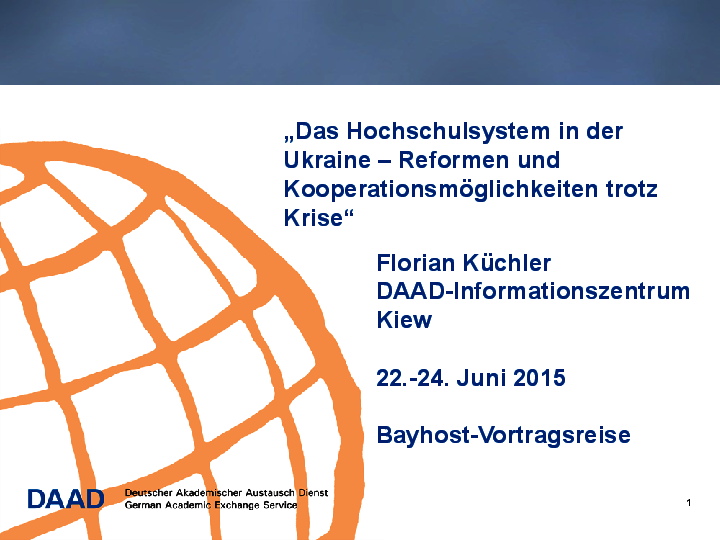
Lecture "The higher education system in Ukraine" by Florian Küchler, DAAD Information Center Kyiv, on 22, 23 and 24 June 2015 at Bavarian universities.
BAYHOST report (PDF) (opens in a new window). (This PDF is not accessible)(in German language only)
DAAD presentation (PDF) (opens in a new window). (This PDF is not accessible)
Visit to the Odesa National Polytechnic University (OPNU) at THA
Two representatives from the partner university, Prof Mykhaylo Lobachev, Director of the Institute of Artificial Intelligence and Robotics and Prof Viktoriia Kryvda, Head of the Doctoral Department at OPNU, visited the Faculty of Informatics and Data Science at Augsburg University of Applied Sciences in November 2024. The focus was on discussions about planning joint activities for the coming years as well as visits to the Faculties of Informatics and Data Science, Electrical and Mechanical Engineering and Process Engineering. It was not just about the traditional exchange at the faculties, but rather about concrete measures in research and teaching that are already underway.
to the report on the OPNU visit (external link, opens in a new window)(in German language only)
Analysis: The new Higher Education Act
Is the Ukrainian higher education system on the move?
The socio-political upheaval initiated by the Maidan has also affected universities: A new progressive and European-oriented Higher Education Act (HG) was passed, which represents a break with the previous (post-)Soviet higher education governance model.
bpb Analysis, 2015 (external link, opens in a new window)(in German language only)
Use of AI in the university research and teaching process
Experiences of Odesa Polytechnic National University (OPNU) and Augsburg University of Applied Sciences (THA)
AI is a key technology of digitalisation with numerous fields of application and is a very dynamically developing field of research.
This technological breakthrough is the most important factor in the development of modern society and is shaping its future. The unique potential of AI systems in all areas of human activity is enormous. The interaction is obvious: we are changing the world with AI and AI is changing our world.
Publication on the experience (PDF) (opens in a new window). (This PDF is not accessible)(in German language only)
Science & Research
Effects of the war
Research perspective Ukraine
The Max Weber Foundation - German Humanities Institutes Abroad is following the ongoing Russian war of aggression against Ukraine with great concern. Shortly after the war began, the first aid and cooperation measures were initiated, including a scholarship program for Ukrainian researchers and support for colleagues from the DHI Moscow to continue their research work on site or outside the country.
Continue to the report of the Max Weber Foundation (external link, opens in a new window) (in German language only)
Universities in Wartime
Voices of students and professors living and teaching through war
Four years after the start of Russia’s full-scale invasion, academic life in Ukraine continues amid resilience, adaptation, and uncertainty. Lecture halls empty during air raid alarms, classes move to shelters, and students are scattered across cities and countries: yet universities remain essential spaces, not only for education but also for preserving a sense of normality and future. to the.
Science in war. Challenges - and opportunities
Russia's invasion of Ukraine is a turning point for science in and about Ukraine and offers numerous challenges as well as opportunities.
Continue to the analysis of the Centre for Eastern European and International Studies (ZOiS) (external link, opens in a new window) (in German language only)
Effects of the war on research and science in Ukraine
Maps and statistics show the impact of Russia's war of aggression on science in Ukraine.
To the analysis by the Centre for Eastern European and International Studies (ZOiS) (external link, opens in a new window) (in German language only)
The state of Ukrainian science in times of war
The Science at Risk Emergency Office analyses the situation of science in Ukraine since the beginning of the Russian invasion.
To the analysis by the Centre for Eastern European and International Studies (ZOiS) (external link, opens in a new window) (in German language only)
A letter from Kharkiv: A Ukrainian science centre in times of war
Kharkiv is the second most important scientific centre in Ukraine after Kyiv and, as a city close to the front, is particularly affected by the war.
Continue to the article by Oleksij Serdjuk (external link, opens in a new window) (in German language only)