

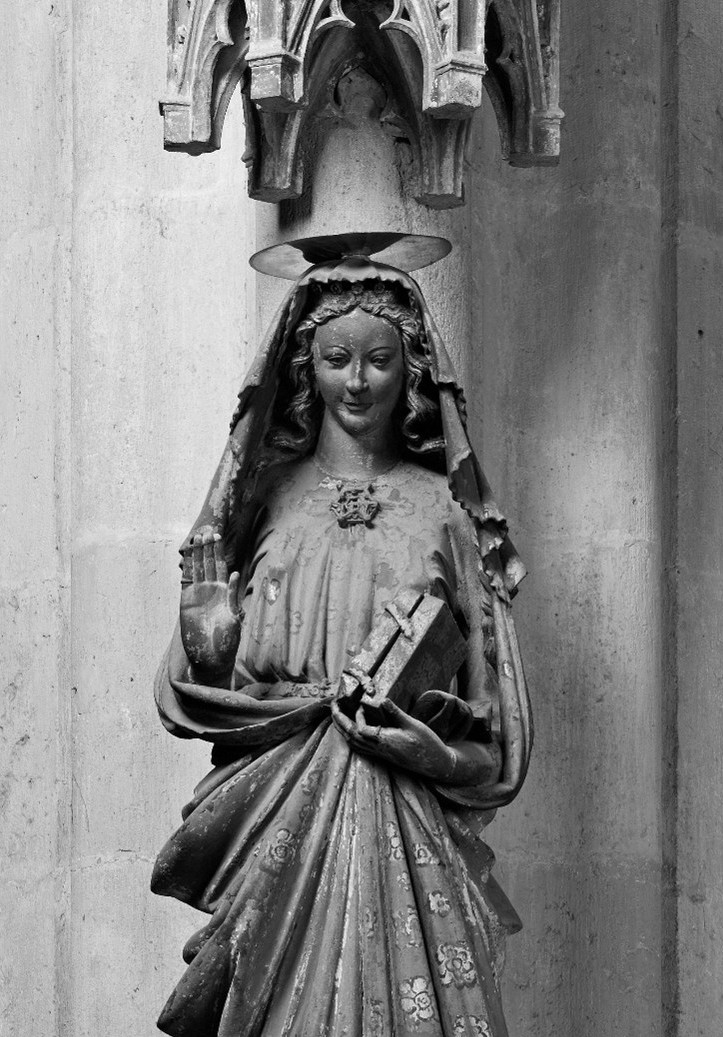
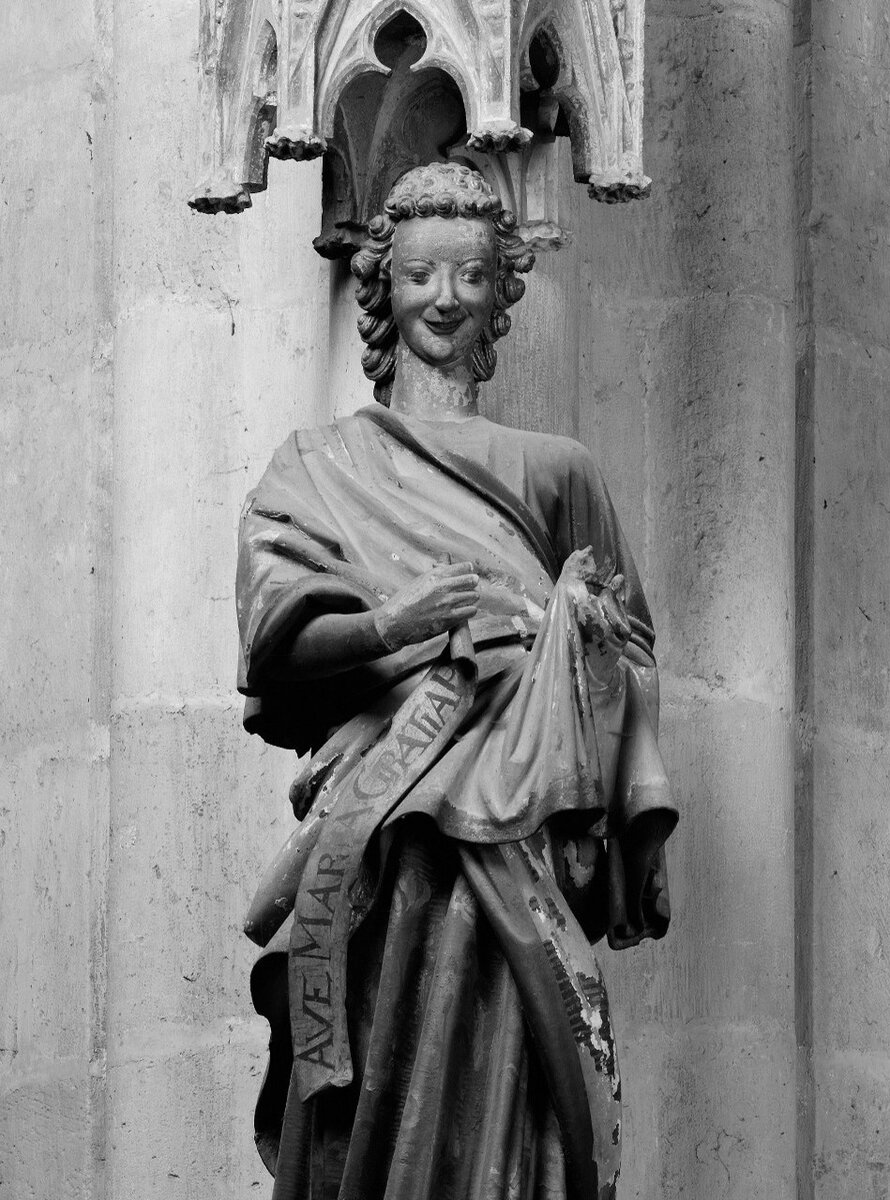
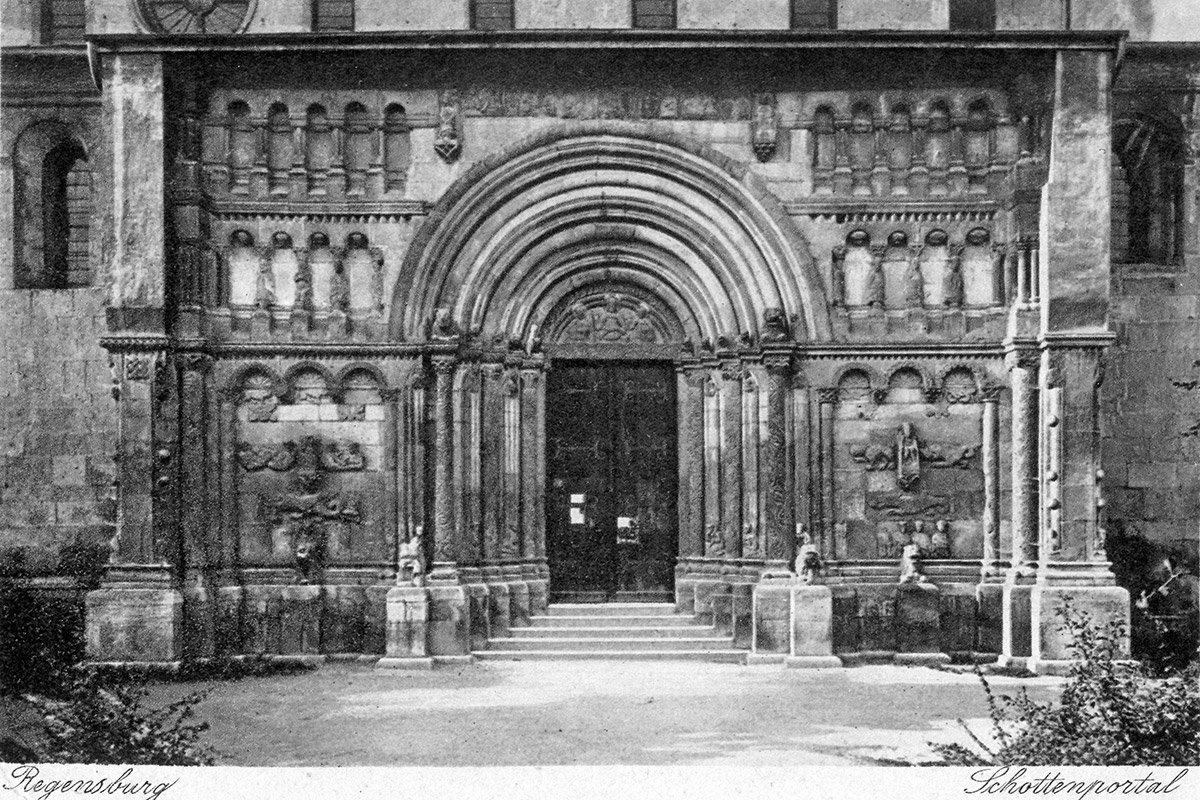
Beckett spent two days and two nights in Regensburg. He arrived on the evening of 02/03/37 from Nuremberg and on 04/03/37, sometime after 4 pm, took the train to Munich. His stay was devoted to walking the city and visiting its sights, especially its most famous churches. In the sculptures of the Dom St. Peter, the Steinerne Brücke, the Jakobskirche or the Basilika St. Emmeram, he found much to engage both his interest in medieval art and his penchant for interrogating the elusive inner lives of the characters, painted or carved in stone, that he studied. The Celtic influences traceable in the iconography of the Schottentor occupied him enough that he wrote to Thomas MacGreevy to ask – using many of the same words as in the diary – if he could help decipher it (letter of 04/03/37); and the figures of the Verkündigungsgruppe sparked speculation about Mary’s thoughts in the very moment of the Annunciation.
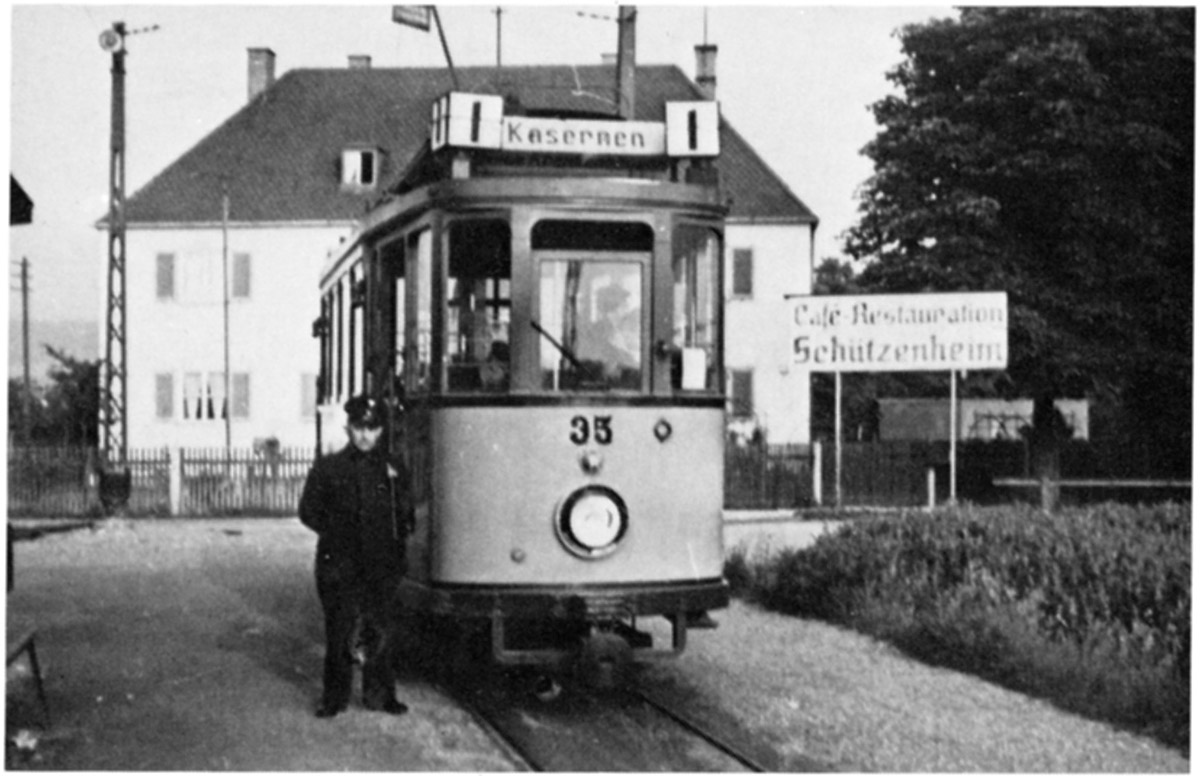
On his second day, Beckett took the tram from Bismarckplatz to Prüfening, where he went to see the tomb of Abbot Erminold in the secularised Benedictine abbey. Crafted by the same sculptor as the Annunciation, the Erminoldmeister, the tomb to Beckett somewhat paled in comparison to the statuary of St. Peter Cathedral, but his characteristically meticulous observation led him to still appreciate details such as the abbot’s gloved hand, his fine nose, and the “[w]onderful crushed cushion under head”.
Another character that captured Beckett’s imagination in Regensburg was the Danube River. He walked along its banks several times and crossed to Stadtamhof to contemplate its confluence with the Regen, which led him, four days later in Munich after looking at the “piddle” of the Isar, to write to MacGreevy of the “heroic Danube in Regensburg” (letter of 07/03/37). But the impressions of his walk, the river and “the mingling” stayed with him far longer: Over four decades later, he would write of it again in Ohio Impromptu.
Dom St. Peter (Display Case #1)
03/03/37
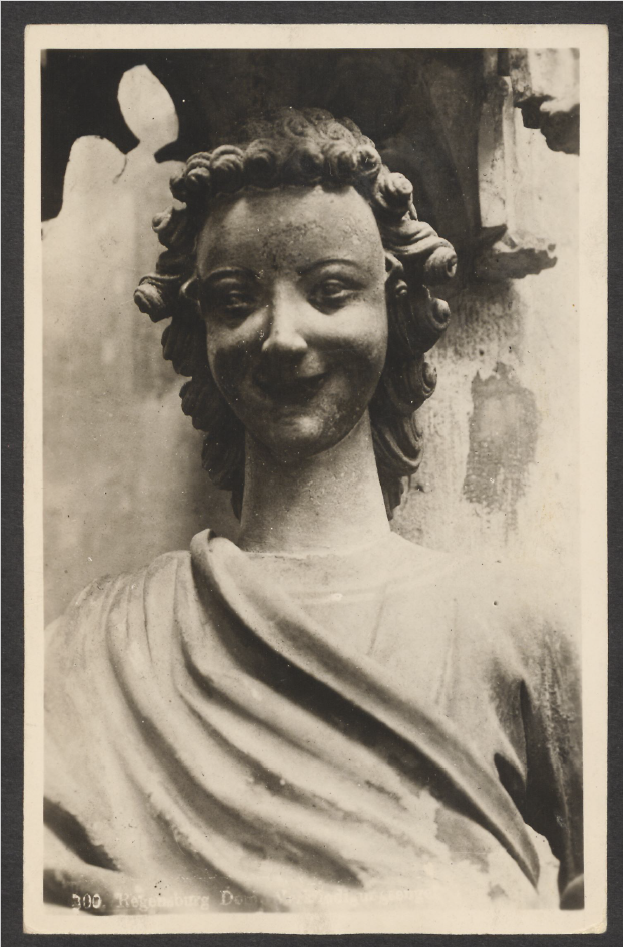
But facing each other across nave from crossing pillars, smiling across at each other, a superb Annunciation by the Erminoldmeister (late 13th century), so called from tomb figure of Abbot Erminold in the Benedictine Cloister Church in Prüfening, a couple of miles W. from Regensburg, where perhaps I may get to to-morrow. Am not sure at first which is which. Both beaming & Virgin holding up a lovely right hand. But the book gives her away. Angels don’t have books. Affinities with the Dionysus angel in Bamberg. And yet not. More lyrical. Angel with delighted look of an express messenger from Irish Hospitals Trust, Mary […] incredulous, flattered, happy, astonished as though by someone bursting in without knocking & interrupting her reading, all written on a surface of doom only to an eye of such permanent biliosity as mine. She has not had time to think it over. Has Gabriel spoken? Does she take him merely – merely! – for an admirer. And so on.
„floating bridge“ / Schwimmbrücke (Display Case #2)
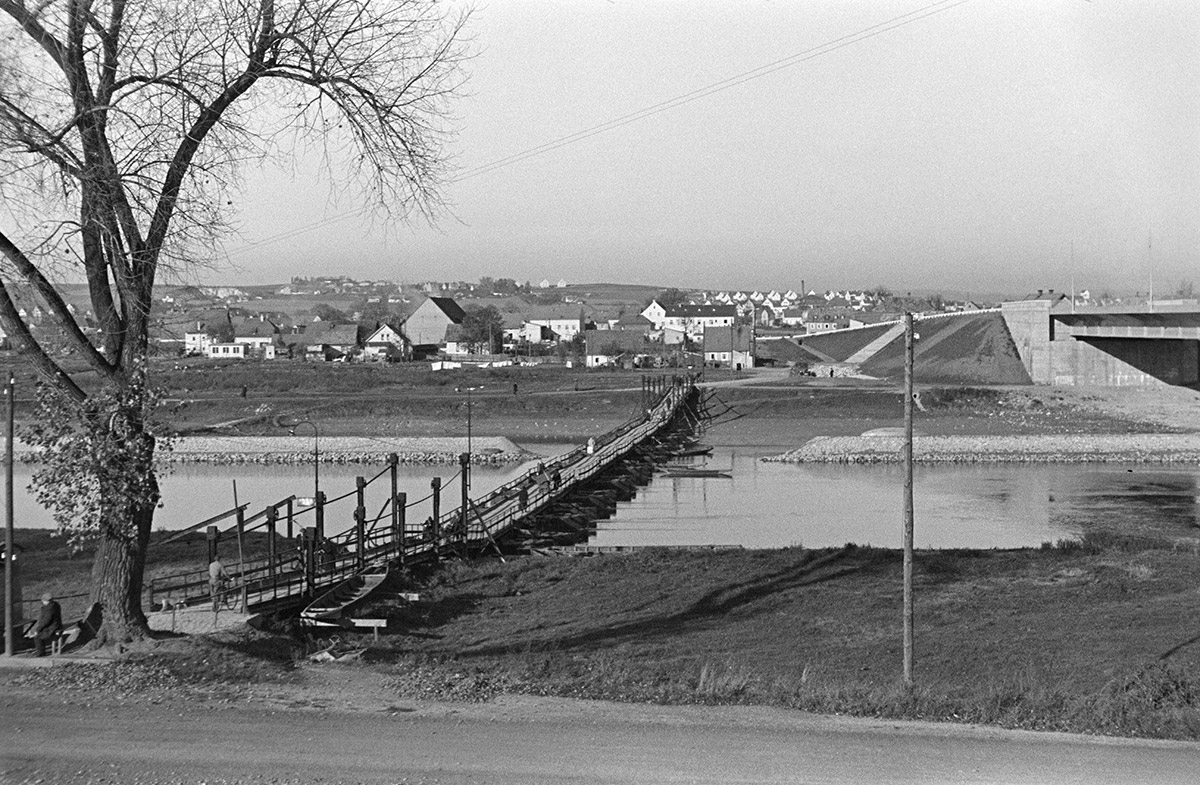
On 03/03/37, Beckett walked across the Steinerne Brücke and then eastward to the bank of what, prior to the construction of the Europakanal in the 1970s, was still the River Regen. Just north of the confluence of Regen and Danube, a pontoon bridge, or floating bridge, connected Stadtamhof to Weichs. The Weichser Steg was privately operated by the Seidl family and cost 5 Pfennige to cross.
Jakobskirche, Schottentor (Display Case #3)
03/03/37
Irish (not Scottish) monks settled here in 11th century […]. So I search for Keltic motivs! A snake! And the shamrock that is never absent & signifies nothing. Innumerable interpretations: as Pronouncement of Evangile; as integration of humanity with God (Endres), with connexions with song of songs; as passing away of heaven & earth (Wiebel) […]. Completely different world from 13th century in Naumburg & Bamberg. In its naiveness (formal) & freedom from naturalism more modern. I know it is wrong to be concerned with what it means, but when one knows one is wrong it is diverting. Walk away past Dominikanerkirche, that I don’t look at, except to see on N. door notice Grüss Gott crossed out & replaced by Heil Hitler!!!
Tram / Straßenbahn (Display Case #4)
Postcard(s)
03/03/37 – Buy postcards of the door & the Annunciation in Dom.
Throughout his journey, Beckett kept up correspondences with a number of friends and family, including the Irish poet and critic Thomas MacGreevy, the bookseller’s assistant Günter Albrecht, whom Beckett had met in Hamburg, his aunt Frances (Cissie) Sinclair, and his mother May.
04/03/37 – Cards in PO to mother & Cissie.
The postcard of “the Annunciation in Dom” that he purchased at the Dombuchhandlung was not posted from Regensburg, though. Beckett kept it for over thirty years and sent it, in March 1969, to the French writer Danielle Collobert.
Books
03/03/37
I ask for Georg Trakl, [refuse?] the complete works & buy him in the Insel Verlag. Buy also the Woerl Regensburg, the only alternative being obviously even worse. […] Find myself back in Neupfarrmkt. Go to Dom Buchhandlung & ask have they anything on the Schottentor. They produce Wiebel’s work, which I buy. Look again at the Zahn (2 RM antiquarisch), it seems good, but I would have no time to use it. Buy postcards of the door & the Annunciation in Dom.
04/03/37
Then wander by Weisse Hahnengasse, having bought Zahn on Dom in Dombuchhandlung […].
Although the visual arts were at the heart of Beckett’s Bildungsreise, they were not his only intellectual pursuit or pastime. He also went to concerts, the theatre and the cinema – and he spent much time buying and reading books. As meticulously as they chronicle art, the Diaries also record the books that were lent and recommended to Beckett, that he bought and read, discussed with others and thought about.
Shown in the display case are the Baedeker travel guide that Beckett purchased in Hamburg on 09/10/36, as well as the four volumes he purchased from Regensburg bookshops: Richard Wiebel‘s Das Schottentor (1927), Karl Zahn‘s Der Dom zu Regensburg (1929), Gesang des Abgeschiedenen: Gedichte (1933) by Georg Trakl, and the Woerl guide Illustrierter Führer durch Regensburg und Umgebung (1931), of which a facsimile is available for perusal.