

Ich saz ûf eime steine
Ich saz ûf eime steine
und dahte bein mit beine,
dar ûf satzt ich den ellenbogen;
ich hete in mîne hant gesmogen
mîn kinne und ein mîn wange.
dô dâhte ich mir vil ange,
wes man zer welte solte leben.
Ich saß auf einem Stein,
und schlug ein Bein über das andere,
darauf stützte ich meinen Ellenbogen
In meine Hand legte ich
mein Kinn und meine Wange
Da dachte ich angstvoll darüber nach,
wie man in der Welt leben sollte.
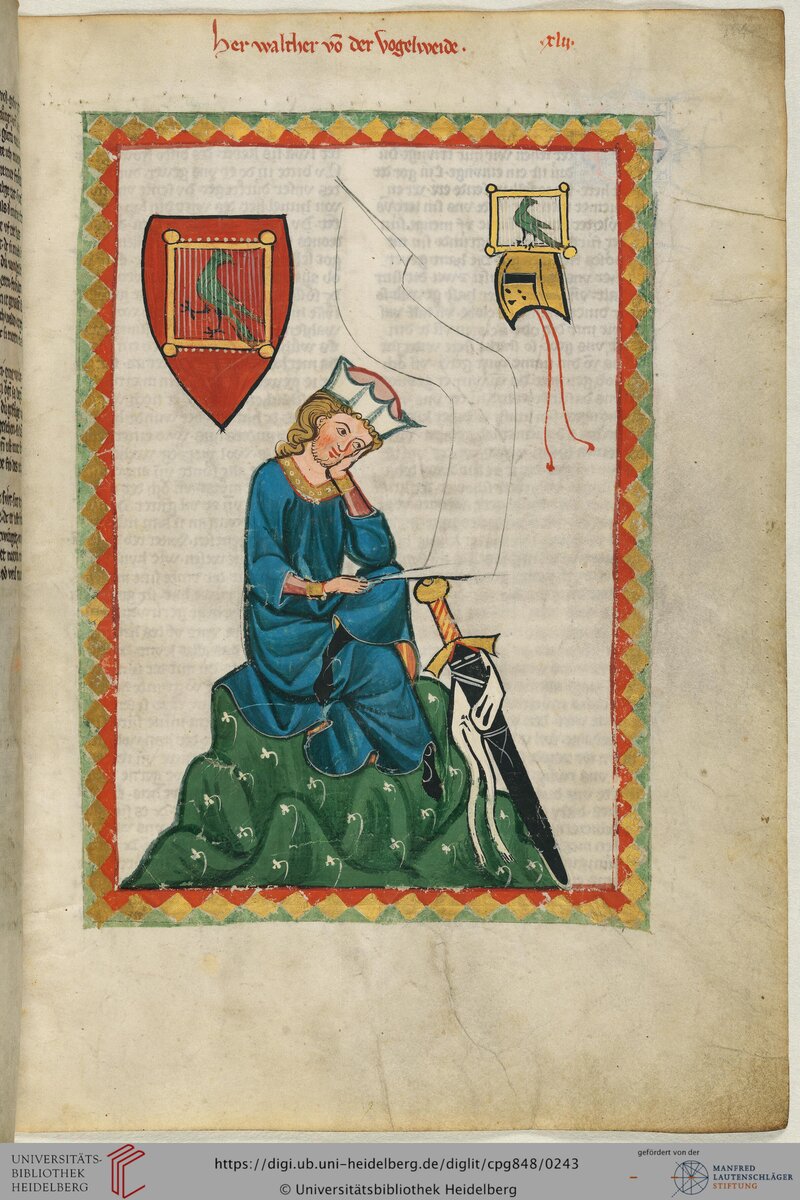

The medieval poet Walther von der Vogelweide appears repeatedly in Beckett's work – albeit exclusively with reference to his political and moral poem Ich saz ûf eime steine, which was written around 1200 as one of Walther's three stanzas in the so-called Reichston. How did this come about? Beckett had already encountered Walther's poetry during his systematic study of J. G. Robertson's A History of German Literature in 1934. On his trip to Germany in Hamburg in November 1936, he bought an anthology of the older German poetry as well as a selection of Walther von der Vogelweide's poetry (Middle German/German) and sent it home to Ireland; finally, he visited Walther's grave in Würzburg. But what significance does this poem have for Beckett? Thomas Hunkeler writes: “Mehrere Kritiker […] haben Becketts Wiederaufnahme von Walthers nachdenklicher Positur auf seinem Stein in Zusammenhang mit Becketts Interesse für Melancholie gestellt [...]. Auch scheint es sinnvoll, Becketts Walther neben andere Figuren in Posituren der Nachdenklichkeit, der Melancholie oder des Verzweifelns zu rücken. Man denke etwa an die Figur Belacqua, wie sie Beckett von Dante übernimmt [...], oder auch an Füsslis oder Balkes Bilder tief in sich versunkener Menschen.” (Wilm/Nixon 2013, 63) However, this general assessment, which extends associatively to the history of art and literature, needs to be refined and expanded: On the one hand, it should be pointed out that Beckett, in typical manner, undermines Walther's postures of thought in the above-mentioned explicit references: in the first instance (The Calmative), the thinker falls asleep (in the story The Expelled (SW IV 248), written around the same time, the figure who is rudely thrown out of the house still takes up the thinker's position while lying down: “I rested my elbow on the sidewalk [...], settled my ear in the cup of my hand and began to reflect on my situation”); in the second instance (Stirrings Still) he lacks the stone, so he simply remains standing, cancelling the process shortly afterwards because he no longer feels like it and/or is tired (“soon weary of vainly delving in those remains he moved on” (SW IV 491)).
As so often in his work, Beckett thus describes the difficulties, the imperfection and the body-bound nature of cognition. On the other hand, Beckett's preoccupation with postures, positions and the interaction of different parts of the body characterises his work throughout, from his early works to his latest works, and plays a central role in his poetics. The importance of this aspect should not be underestimated: Beckett collects characteristic visual gestures, attitudes and postures from the history of art, culture and literature (as on his trip to Germany) and uses them recurrently in his work – which not only has an oeuvre-building effect, but is also a way of incorporating the author into the literary work through his reading and travelling biography. However, the ‘Walther pose’ is of even greater significance in another respect: the immobilisation of the physical body, which makes the cognitive activities of thought, imagination and memory possible in the first place, is a central Beckettian motif from his first novel Murphy (1936) onwards.
Many creatures in Beckett’s work take up related supporting positions: “one on top of the other the hands weigh on the stick, the head weighs on the hands” (Fizzles 3, SW IV 408); “You lean on a long staff. Your hands rest on the knob and on them your head.” (Company, SW IV 446); “One night as he sat trembling head in hands” (Ohio Impromptu, SW III 471); “Hand resting on hand on some convenient support. Such as the foot of her bed. And on them her head. There then she sits as though turned to stone face to the night.” (Ill Seen Ill Said, SW IV 451) Through this posture of thought and imagination, moreover, the author is again introduced into the literary work as a dramatised creature, as “Devised deviser devising it all for company. In the same figment dark as his figments.” (Company, SW IV 443), “in the same dark as his creature” (Company, SW IV 442), “Shade with the other shades” (Worstward Ho, SW IV 475), “scene and seer of all” (Worstward Ho, SW IV 477), “seat of all. Germ of all.” (Worstward Ho, SW IV 475) – an author whom his creatures sometimes perceive from the corner of their eye (“Out of the corner of my eye I observe the writing hand”, Texts for Nothing 5, SW IV 310), who lives bent over them (“he lives bent over me that’s the life he has been given”, How It Is, SW II 420) and who, with closed physical eyes, opens on them the clenched staring eyes of the imagination (“Le train ne peut partir que les paupières fermées.”, Dream of Fair to Middling Women, Beckett 1992, 45; “the lids of the mind”, ibid., 63; “my eyes not the blue the others at the back“, How It Is, SW II 428; “To close the eyes and see that hand”, Company, SW IV 433) „an eye having no need of light to see” Ill Seen Ill Said, SW IV 451; “Nor by the eye of flesh nor by the other.” Ill Seen Ill Said, SW IV 455; “Clenched staring eyes”, Worstward Ho, SW IV 476). In many texts, he does this work of imagination with his head resting on his hands, “bowed head resting on hands” (Nacht und Träume, SW III 489), “Head sunk on crippled hands” (Worstward Ho, SW IV 473), “at his table head on hands“ (Stirrings Still, SW IV 487). The stone, too, appears again and again in this context, as in That Time, Beckett‘s central work on the connection between memory and imagination: Here, „on the stone“ is the most frequent phrase in the entire text, and the child who invents voices while sitting on the stone is the clear fictional-biographical prefiguration of the later author – „on a stone among the giant nettles making it up now one voice now another” (SW III 415). In his favourite German author, Theodor Fontane, Beckett may have found an echo of this motif:“Und so ging er denn weiter die Straße hinab, während sie, den Kopf auf den Arm und den Arm auf den Gitterpfosten gestützt, ihm mit großem Auge nachsah.“ (Fontane, Irrungen, Wirrungen, 107) Building on this rich collection of figures and figurations, Beckett once again explicitly places his authorial attitude in Stirrings Still in the history of attitudes of thought since Walther von der Vogelweide, thus drawing attention to an entire branch of cultural history. The fact that he takes up this explicit reference again in his last prose work shows the weight and centrality of this theme and of Walther's pose – in a work that imagines the author's own death: „One night as he sat at his table head on hands he saw himself rise and go.“ (Stirrings Still, SW IV 487)
Further reading/sources: Wilm/Nixon 2013, 61-63; Van Hulle/Nixon 2013, 84-85.