


It is not clear when Samuel Beckett first encountered Franz Kafka's work – perhaps, as Van Hulle and Nixon speculate, as early as around 1930 in English translation (Van Hulle/Nixon 2013, 101). By the 1950s at the latest, however, there is clear evidence of Beckett’s reading of Kafka, not only in his work, but also in letters and interviews – in which he signalled that he had not read Kafka extensively, partly because of a certain ‘anxiety of influence’, a feeling that this writer was too close to him: “Je m'y suis senti chez moi, trop, c'est peut-être cela qui m'a empêché de continuer.” (1954; Letters II 462) As he said in an interview with Israel Shenker in the New York Times in 1956, he had until then only read Das Schloss in German and some other pieces in French and English (there is also evidence that he had read Der Prozess). In this interview, however, he also diagnosed a clear difference between himself and Kafka: "The Kafka hero has a coherence of purpose. He's lost but he's not spiritually precarious, he's not falling to bits. My people seem to be falling to bits. Another difference. You notice how Kafka's form is classic, it goes on like a steamroller – almost serene. It seems to be threatened the whole time – but the consternation is in the form. In my work there is consternation behind the form, not in the form." He repeatedly stated this perception: “Sam also said Kafka's subject-matter called for a more disjointed style.“ (Atik 2001, 66); “What struck me as strange in Kafka was that the form is not shaken by the experience it conveys” (1962, letter to Ruby Cohn, quoted in Van Hulle/Nixon 2013, 101). However, this conflict between similarity and contrast already reveals Beckett’s intense engagement with Kafka’s work, which continued into his later years: In 1982, Beckett read a biography of Kafka as well as the latter’s diaries (Letters IV 588-592, 604; “that luckless great man”, Letters IV, 590), and even in the last year of his life, Kafka was among the few books in his room (Knowlson 1996, 701).
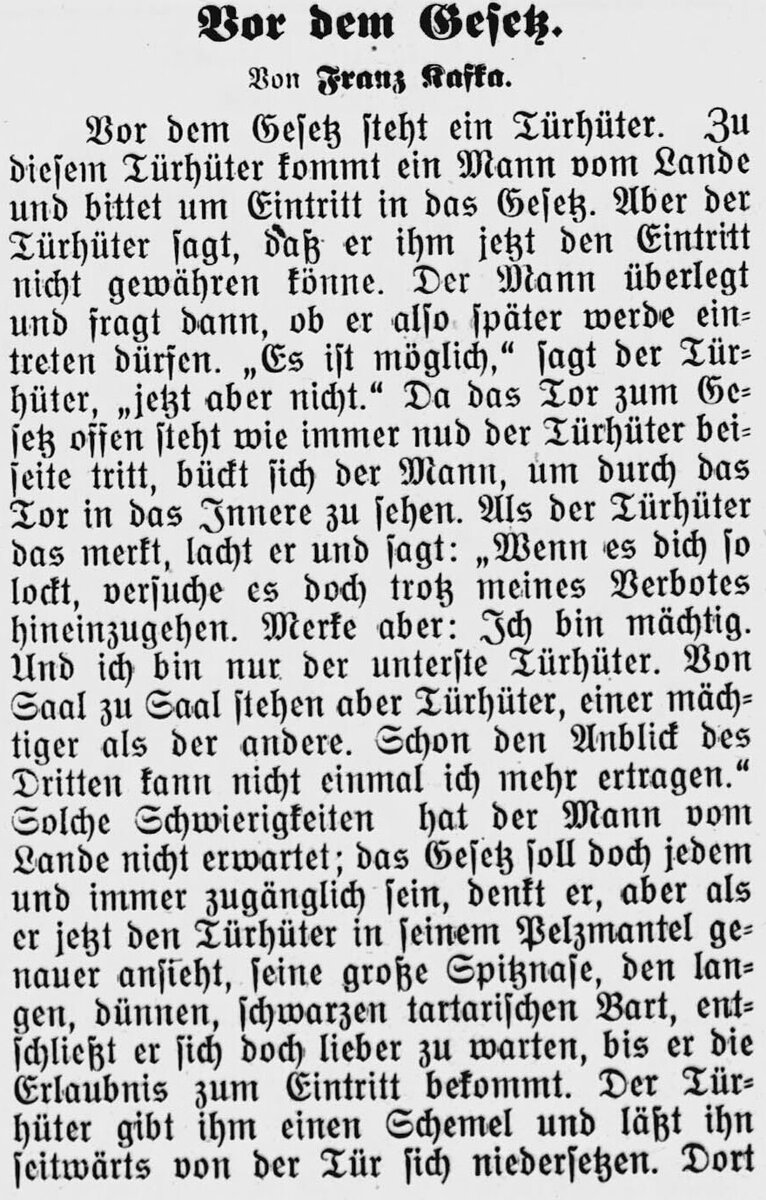
One text by Kafka in particular is repeatedly and clearly reflected in Beckett's work and, like Walther von der Vogelweide, assumes a structural poetological function: the famous parable of the doorkeeper, part of the great novel Der Prozess (Chapter 9) and first published separately as "Vor dem Gesetz" in 1915. Kafka's story of the "countryman" who spends his life trying to enter the law, asking countless questions about it and yet failing to find the right solution until his death, becomes a central motif for Beckett from the 1950s onwards at the latest – Beckett’s characters are constantly searching for the one solution, the one word that will redeem them from their fate, meet the external demands, and open the door to their story: “If they had told me what I have to say, in order to meet with their approval, I’d be bound to say it, sooner or later.” […] “Perhaps I’ve said the thing that had to be said, that gives me the right to be done with speech […], without knowing it.” […] “perhaps they have carried me to the threshold of my story, before the door that opens on my story” (The Unnamable, SW II 329, 387, 407).
The significance of this topos is continually expanded throughout Beckett's post-war work: In “As the Story Was Told,” published in 1973 by Suhrkamp as a commissioned contribution to a memorial volume for Günter Eich, Beckett, influenced by his experiences in the French Resistance, connects it with the topic of torture (whether this is also a statement directed at Eich is an open research question: Beckett met Günter Eich in March 1961 (Wilm/Nixon 2013, 28), but, according to his own statement, hardly knew him and initially did not really know what he should contribute to the memorial volume; Letters IV 340-341): A voice reports on torture sessions that were held in a nearby tent (“As the story was told me I never went near the place during sessions. […] I asked what sessions and these in in their turn were described, their object, duration, frequency and harrowing nature.” SW IV 423). The voice itself recognizes that its role was to wait for a specific statement from the tortured person – the statements are continuously transmitted to it in writing: “as I watched a hand appeared in the doorway and held out to me a sheet of writing. I took and read it, then tore it in four and put the pieces in the waiting hand to take away.” (SW IV 424) But even the person who appears to be the ruler and the one who commissioned the attack cannot say what the redeeming word would have been that would have spared the man his torment: “But finally I asked if I knew exactly what the man – I would like to give his name but cannot – what exactly was required of the man, what it was that he would not or could not say. No, was the answer, after some little hesitation, no, I did not know what the poor man was required to say, in order to be pardoned, but would have recognized it at once, yes, at a glance, if I had seen it.” (SW IV 424) Beckett takes up this expanded topos again in his last play What Where, in which the creatures interrogate each other under torture in order to extract the one word:
“BAM: You gave him the works?
BOM: Yes.
BAM: And he didn’t say it?
BOM: No.
BAM: He wept?
BOM: Yes.
BAM: Screamed?
BOM: Yes.
BAM: Begged for mercy?
BOM: Yes.
BAM: But didn’t say it?
BOM: No.
BAM: The why stop?
BOM: He passed out.”
(What Where, SW III, 496)
The significance of torture in Beckett’s work is another open research question – connections can certainly be drawn here to Kafka’s In der Strafkolonie, one of the most shocking depictions of this topic in the 20th century, which is connected to Beckett via the topos of writing as carving into skin (compare How It Is: “with the nail of the right index I carve […] from left to right and top to bottom as in our civilisation I carve my Roman capitals” […], “nail on skin”; SW II 460, 474). A further level of meaning of this topos can be seen in Texts for Nothing 5: “This evening, the session is calm, there are long silences when all fix their eyes on me, that’s to make me fly off my hinges, I feel on the brisk of shrieks, it’s noted. Out of the corner of my eye I observe the writing hand, all dimmed and blurred by the – by the reverse of farness.” (SW IV 310) The "sessions“ here are also writing sessions, the author is the torturer, the creature the victim – in a figurative sense, it ultimately refers to the author's agonizing search for the one word that concludes his text, that allows him and his characters to end (and only the author will eventually know when it will have been the right word). Beckett thus uses the topos again to inscribe the author as a character into the work. In his last prose text, Beckett expands the scope of meaning once again: the aging author is again searching for the one word, “a word he could not catch” – “that missing word” (Stirrings Still, SW IV 492), accompanied by "strokes and cries“ (489), which initially denote human sounds and bells ringing through the open window, but also reintroduce the motif of torture – the author is thus tortured by the striking of the clock, by the passing of time, and continues to search for the redeeming word that will allow him to end: "Time and grief and self so-called. Oh all to end.“ (492). Beckett's last published text, the poem "What Is the Word", takes up this theme again and adds a further, theological level of meaning – the inherent human longing and futile task remains to ask what the divine word is ("In the beginning was the Word"):
„folly for to need to seem to glimpse afaint afar away over there what –
what –
what is the word –
what is the word”
(SW IV 51)
The fact that Beckett takes up the topos of the agonising search for the one redeeming word in his last prose work (Stirrings Still), his last play (What Where) and in his last poem (“What Is the Word”) impressively demonstrates its centrality – and the importance of Kafka for his work.
Further reading/sources: Van Hulle/Nixon 2013; Knowlson 1996; Ricks 1987.