


Samuel Beckett, one of the best-known and most popular writers of the 20th century, is, as an Irishman, usually categorised as part of Irish literary history, although he initially wrote many of his works in French. What is less well known is that Beckett had an extensive knowledge of Italian and German in addition to English and French – accordingly, his texts are interspersed with expressions and allusions from these languages. But it is not only in this sense that Beckett is a multilingual author: to read Beckett's work is to learn the multitude of languages he uses, to explore the variety of means he employs for communication and literary composition. These include not only foreign languages, special and technical terminology, obsolete and remote words, neologisms, quotations, repetitions, elliptical syntax or linguistic “micro-prisons” (created through self-contradiction, such as in ‘on’), but also gestures and postures, movements and obstructions, spatial configurations, music and silence, sounds, colours, temperatures, points of the compass, camera perspectives and much more. The visit to the “German Room”, as an attempt to explore Beckett’s intense relationship with the German language, with German literature and culture, is therefore only a small part of the long-term project to which every Beckett reader must dedicate themselves: learning to understand the multitude of his languages.
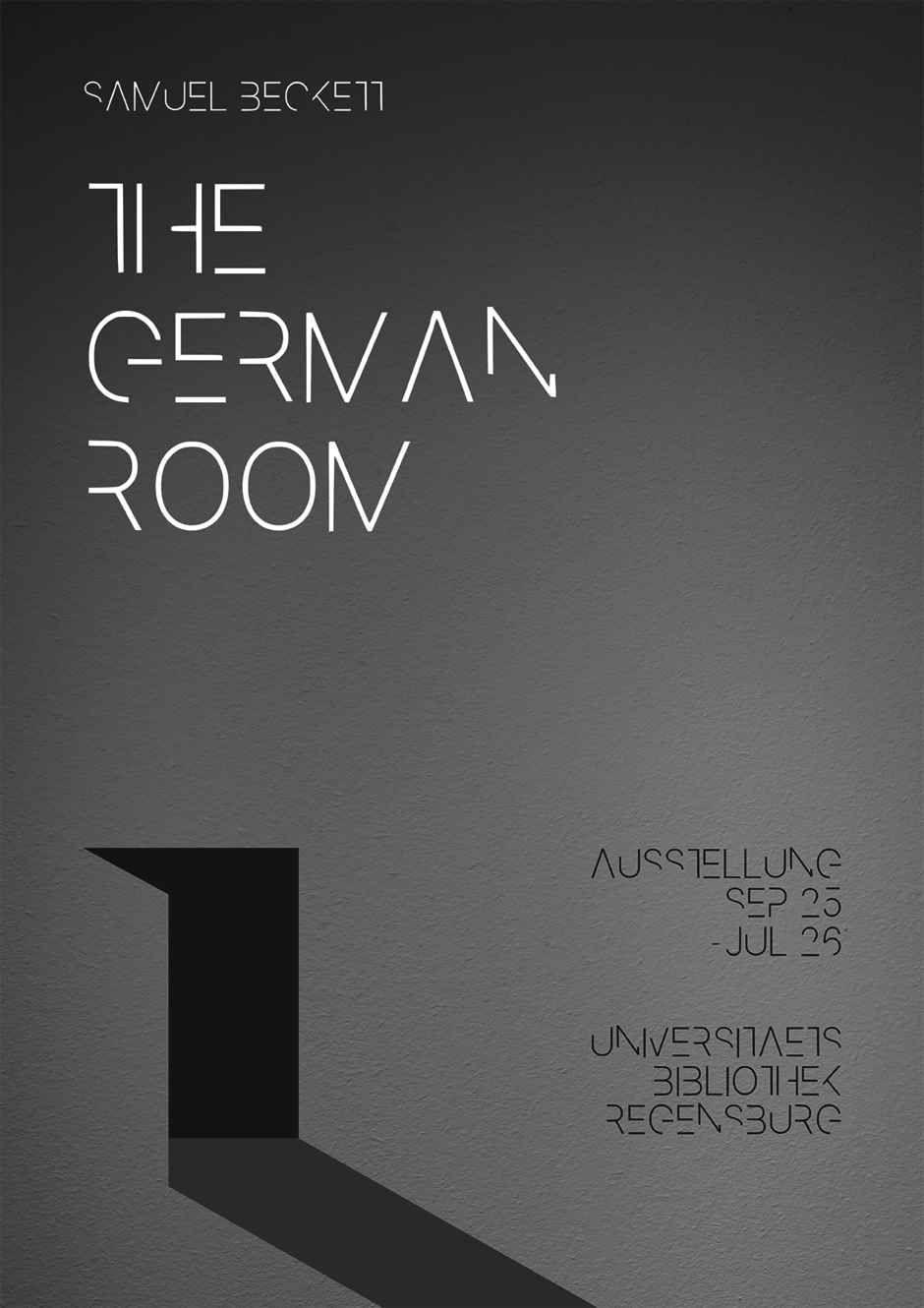
The fact that this experiment takes place in a closed room is part of the exhibition concept: Beckett’s figures – including the artificial author figures that coexist with his other creatures – mostly live in closed rooms, with no way out except by imagination and memory. The expression ‘The German Room’ alludes to Beckett’s early story ‘Dante and the Lobster’, where – after describing the location of the “French room” in the language academy – it says: ‘God knows where the German room was.’ The exhibition thus, finally, opens Beckett's “German Room” to the public and invites visitors to familiarise themselves with – and to learn to read – the many dimensions of the ‘German Beckett’.
In addition to Beckett’s use of the German language in his works and letters (Beckett´s German), which is illustrated through a large number of quotations, the exhibition is dedicated to four areas in particular:
This module of the exhibition is dedicated in particular to the German translations of Samuel Beckett’s works. In close co-operation with the Tophoven Archive in Straelen, we are able to present unique testimonies to the work of Elmar and Erika Tophoven, who were close friends of Beckett since the 1950s and translated his works into German.

Beckett visited Germany repeatedly throughout his life and realised important directorial works here, for example in 1977 at the Akademie der Künste, Berlin, or between 1966 and 1985 in cooperation with the Süddeutscher Rundfunk in Stuttgart (an exhibition on the latter cooperation was held at the Württembergischer Kunstverein in Stuttgart in 2024/2025). However, Beckett’s longest stay was probably his trip to Germany in 1936 and 1937, during which he visited numerous German cities and viewed a large number of works of art. The exhibition illustrates this journey with a map and quotations from Beckett’s ‘German Diaries’, in which he documented this trip in a detailed, amusing and highly informative way. The first scholarly edition of these ‘German Diaries’, edited by Mark Nixon and Oliver Lubrich, will soon be published by Suhrkamp.

Beckett had a similarly comprehensive reading knowledge of international literatures as his encyclopaedic contemporaries James Joyce, T. S. Eliot and Ezra Pound. His intense and wide-ranging reading of German-language authors is reflected in his literary work as well as in his letters. Beyond the mere search for intertexts and biographical evidence, however, the exhibition is dedicated in particular to the question of the functions that literature, and German-language literature in particular, has in Beckett's work; in doing so, it also extends the focus to music, which is closely interwoven with language and literature in Beckett’s work.

Beckett’s decades-long collaboration with the Suhrkamp publishing house was documented in a comprehensive exhibition at the Deutsches Literaturarchiv in Marbach in 2017. The Regensburg exhibition is the first to show evidence of Beckett’s collaboration with the Stuttgart publisher Roland Hänßel – the correspondence between Beckett and Hänßel, which is held by the Regensburg University Library, takes centre stage here. The collaboration with Hänßel resulted in five joint publications by Manus Presse, which were illustrated by contemporary artists, including Max Ernst.
The exhibition will be accompanied by an academic programme organised by Dr Georgina Nugent (University College Cork) and a cultural programme with concerts, film screenings and public discussions. The exhibition is organised by the University Library in cooperation with the Tophoven Archive in Straelen and the Beckett Archive in Reading. Materials from the exhibition and the academic programme will be published in a special issue of the journal Samuel Beckett Today / Aujourd'hui (SBT/A).
Accompanying events:
- Exhibition opening with academic programme, 22.09.2025
- Lange Nacht der Museen Regensburg, 25.10.2025, 18:00 - 01:00
- Film presentation and concert: Beckett/Beethoven: Ghost Trio/Geistertrio, 13.11.2025, 18:00 (in German)
- A one-day conference in conjunction with the German Room Exhibition, 19.01.2026, 14:00
- Beckett: Tritte & Nicht Ich. Double Feature, theater performance, 07.05.-09.05.2026, 19:30 and 10.05.2026, 18:00, University Theater (in German)
- Public guided English tour led by Dr. André Schüller-Zwierlein, 02.06.2026, 12:00, Meeting point: schaufenster exhibition space, Central Library, free of charge