
While in Dresden between 29/01 and 19/02/37, Beckett visited the Gemäldegalerie nine times, both for its collection of Old Masters and its modern wing. Over a week in February, he was also twice invited to see the private collection of Ida Bienert, which comprised works by, amongst others, artists of the Bauhaus school like Wassily Kandinsky, whose Träumerische Improvisation Beckett was especially impressed with. Bienert gifted Beckett the catalogue of her collection “on condition that I show it to nobody in Germany” (15/02/37), because it had been compiled by Will Grohmann, a Jewish art historian. The work of Kandinsky and the critical lens through which Grohmann read it later made their way onto the pages of Beckett’s second novel, Watt (1953).
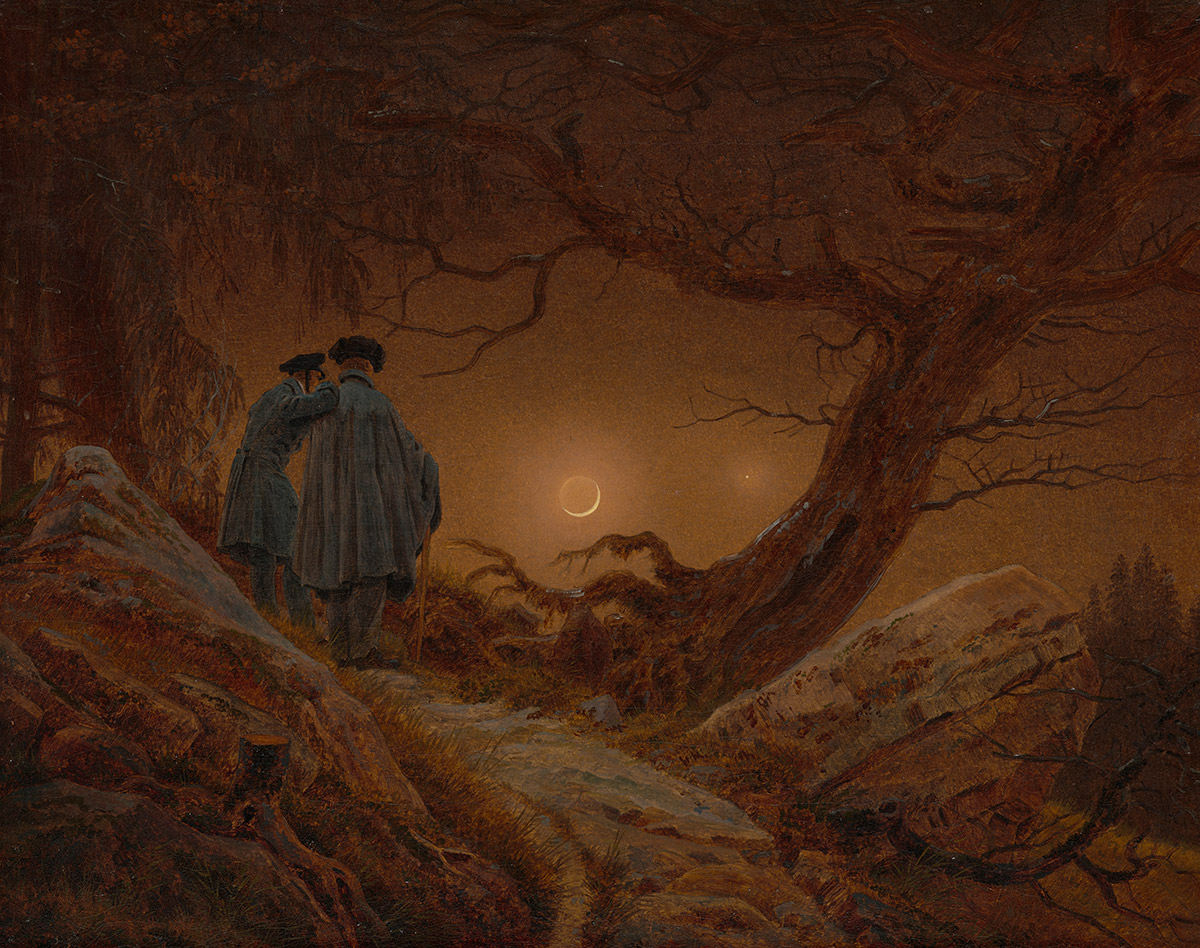
Another painting that left its mark on his work was Zwei Männer in Betrachtung des Mondes. Its visual composition informs Waiting for Godot and the lack of depth that Beckett, borrowing terminology from music theory, called “bémolisé”, would emerge as a central component of his thinking about the relationship between art and reality.
Wassily Kandinsky, Träumerische Improvisation, 1913, Bayerische Staatsgemäldesammlungen – Sammlung Moderne Kunst in der Pinakothek der Moderne München, URL: https://www.sammlung.pinakothek.de/de/artwork/01G1Bqy4kE (external link, opens in a new window)