

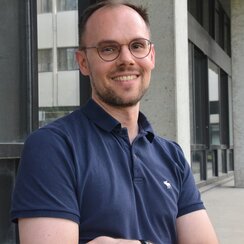
Dr. Tobias Debatin
Wissenschaftlicher Mitarbeiter
- E-Mail Adresse: tobias.debatin(at)ur.de (öffnet Ihr E-Mail-Programm)
- Tel: 0941-943-1750 (startet einen Telefonanruf, wenn Ihr Gerät dies zulässt)
- Standort: PT, 5.1.08
-
Wichtige Informationen: Sprechzeiten in der Vorlesungszeit: Dienstag, 11:00-12:00 Uhr mit E-Mail Voranmeldung.
Sprechzeiten in der vorlesungsfreien Zeit: nach Vereinbarung.
Forschung
Habilitationsvorhaben: Self-concept and educational choices in STEM: A research program on developmental aspects, interventions, and gender differences
- self-concept development
- educational and career choices in STEM
- gender differences
- learning environments
- cognitive ability
- MINT-Mädchenförderung/Mentoring
- A Gifted Identification Kit for the United Arab Emirates: Identifying and Developing High Potentials
Publikationen
Debatin, T., Stoeger, H., & Ziegler A. (2026) The underestimated role of effort in ability self-concept formation: Preliminary evidence for another major comparison process. Learning and Instruction, 107, 102471. https://doi.org/10.1016/j.learninstruc.2026.102471 (externer Link, öffnet neues Fenster)
Debatin, T., Stoeger, H., & Ziegler, A. (2025). Are competence beliefs or value beliefs more important for STEM career aspirations?—Longitudinal mediation analyses based on recent modeling approaches show different results. Journal of Youth and Adolescence, 54, 1768-1778. https://doi.org/10.1007/s10964-025-02162-3 (externer Link, öffnet neues Fenster)
Debatin, T., Stoeger H., & Ziegler, A. (2023). Modeling social, dimensional, and temporal comparisons in self-concept development with the random intercept cross-lagged panel model: A methodological-substantive integration. Developmental Psychology, 59(9), 1595-1607. https://doi.org/10.1037/dev0001568 (externer Link, öffnet neues Fenster)
Stoeger, H., Debatin, T., Heilemann, M., Schirner, S., & Ziegler, A. (2023). Online mentoring for girls in secondary education to increase participation rates of women in STEM: A longterm follow-up study on later university major and career choices. Annals of the New York Academy of Sciences, 1523(1), 62-73. https://doi.org/10.1111/nyas.14989 (externer Link, öffnet neues Fenster)
Awad, S., Debatin, T., & Ziegler, A. (2021). Embodiment: I sat, I felt, I performed – Posture effects on mood and cognitive performance. Acta Psychologica, 218, 103353. https://doi.org/10.1016/j.actpsy.2021.103353 (externer Link, öffnet neues Fenster)
Debatin, T., Hopp, M. D. S., Vialle, W., & Ziegler, A. (2021). The meta-analyses of deliberate practice underestimate the effect size because they neglect the core characteristic of individualization—an analysis and empirical evidence. Current Psychology. Advance online publication. https://doi.org/10.1007/s12144-021-02326-x (externer Link, öffnet neues Fenster)
Stoeger, H., Heilemann, M., Debatin, T., Hopp, M. D. S., Schirner, S., & Ziegler, A. (2021). Nine years of online mentoring for secondary school girls in STEM: an empirical comparison of three mentoring formats. Annals of the New York Academy of Sciences, 1483, 153-173. https://doi.org/10.1111/nyas.14476 (externer Link, öffnet neues Fenster)
Debatin, T. (2020). Neuroenergetics and “general intelligence”: A systems biology perspective. Journal of Intelligence, 8(3), 31. https://doi.org/10.3390/jintelligence8030031 (externer Link, öffnet neues Fenster)
Debatin, T. (2020). Was messen IQ-Werte? – Eine aktualisierte Interpretation unter Berücksichtigung moderner Methoden und Perspektiven [Univ., Diss., online]. Erlangen-Nürnberg: OPUS FAU.
Stoeger, H., Debatin, T., Heilemann, M., & Ziegler, A. (2019). Online mentoring for talented girls in STEM: The role of relationship quality and changes in learning environments in explaining mentoring success. New Directions for Child and Adolescent Development, 168, 75–99. https://doi.org/10.1002/cad.20320 (externer Link, öffnet neues Fenster)
Debatin, T. (2019). A revised mental energy hypothesis of the g factor in light of recent neuroscience. Review of General Psychology, 23(2), 201–210. https://doi.org/10.1177/1089268019832846 (externer Link, öffnet neues Fenster)
Debatin, T., Harder, B., & Ziegler, A. (2019). Does fluid intelligence facilitate the learning of English as a foreign language? — A longitudinal latent growth curve analysis. Learning and Individual Differences, 71, 121–129. https://doi.org/10.1016/j.lindif.2019.01.009 (externer Link, öffnet neues Fenster)
Stoeger, H., Debatin, T., Heilemann, M., & Ziegler, A. (2019). Online mentoring for talented girls in STEM: The role of relationship quality and changes in learning environments in explaining mentoring success. New Directions for Child and Adolescent Development, 168, 75-99. https://doi.org/10.1002/cad.20320 (externer Link, öffnet neues Fenster)
Ziegler, A., Debatin, T., & Stoeger, H. (2019). Learning resources and talent development from a systemic point of view. Annals of the New York Academy of Sciences, 1445, 39-51. https://doi.org/10.1111/nyas.14018 (externer Link, öffnet neues Fenster)
Debatin, T., Aljughaiman, A., AlGhawi, M., Stoeger, H., & Ziegler, A. (2018). Reliability and interpretation of total scores from multidimensional cognitive measures—evaluating the GIK 4–6 using bifactor analysis. Psychological Test and Assessment Modeling, 60(4), 393–401.
Harder, B., O’Reilly, C., & Debatin, T. (2018). Intelligence, educational and learning capital, and domain impact level of activities as predictors of school achievement. Journal for the Education of the Gifted, 41(4), 327–347. https://doi.org/10.1177/0162353218799440 (externer Link, öffnet neues Fenster)
Stöger, H., Debatin, T. & Ziegler, A. (2017). Erste Schritte zu einer systemischen Begabungsdiagnostik: Ein Paradigmenwechsel von der Potenzialfeststellung zur Exzellenzvorhersage. In U. Trautwein & M. Hasselhorn (Hrsg.), Begabungen und Talente (Tests und Trends – Jahrbuch der pädagogisch-psychologischen Diagnostik) (S. 31-48). Göttingen: Hogrefe.
Debatin, T., Hopp, M., Vialle, W., & Ziegler, A. (2015). Why experts can do what they do: The effects of exogenous resources on the domain impact level of activities (DILA). Psychological Test and Assessment Modeling, 57(1), 94–110.
Vorträge
Debatin, T. (2025). Die unterschätzte Rolle der Anstrengung bei der Entstehung des Fähigkeitsselbstkonzepts: Evidenz für einen weiteren wichtigen Vergleichsprozess. Präsentation auf der 20. Fachgruppentagung Pädagogische Psychologie, Jena, Deutschland.
Debatin, T. (2024). Reexamining effects of competence-related beliefs and value beliefs on STEM career aspirations with new longitudinal mediation models. Präsentation auf dem 53. DGPs-Kongress/15. ÖGP-Konferenz in Wien, Österreich.
Debatin, T. (2023). A Methodological-Substantive Integration of the Random Intercept Cross-Lagged Panel Model in the Context of the Three Major Comparison Processes in Self-Concept Development. Präsentation auf der 19. Fachgruppentagung Pädagogische Psychologie, Kiel, Deutschland.
Debatin, T. (2022). Reciprocal relations, stability and gender differences in the development of career aspirations in STEM. Präsentation auf der 17th International Conference on Motivation (ICM 2022), Dresden, Deutschland.
Matthes, B., Almulhim, N., Debatin, T., AlGhawi, M., Aljughaiman, A., Ziegler, A., & Stoeger, H. (2019). Thinking dispositions—a worthwhile criterion for identifying giftedness? Präsentation auf der 2019 Biennial Conference of the International Research Association for Talent Development and Excellence (IRATDE), Taipei, Taiwan.
Debatin, T., M., Aljughaiman, AlGhawi, A., Stoeger, H., & Ziegler, A. (2018). Evaluating the Psychometric Properties of the Gifted Identification Kit (GIK) 4–6 Using a Factor-Analytic Approach. Präsentation auf der 16th International ECHA Conference, Dublin, Irland.
Debatin, T., & Wimmer, B. (2017). Quantifying the Influence of Writing Direction on Solving a Matrices-Based Nonverbal Ability Test. Präsentation auf der 2017 Biennial Conference of the International Research Association for Talent Development and Excellence (IRATDE), Dubai, UAE.
Debatin, T. (2017) Eine Aktualisierung Spearmans Interpretation des g-Faktors als „mentale Energie“ angesichts moderner neurowissenschaftlicher Befunde. Präsentation auf der 14. Arbeitstagung der Fachgruppe Differentielle Psychologie, Persönlichkeitspsychologie und Psychologische Diagnostik (DPPD), München, Deutschland.